
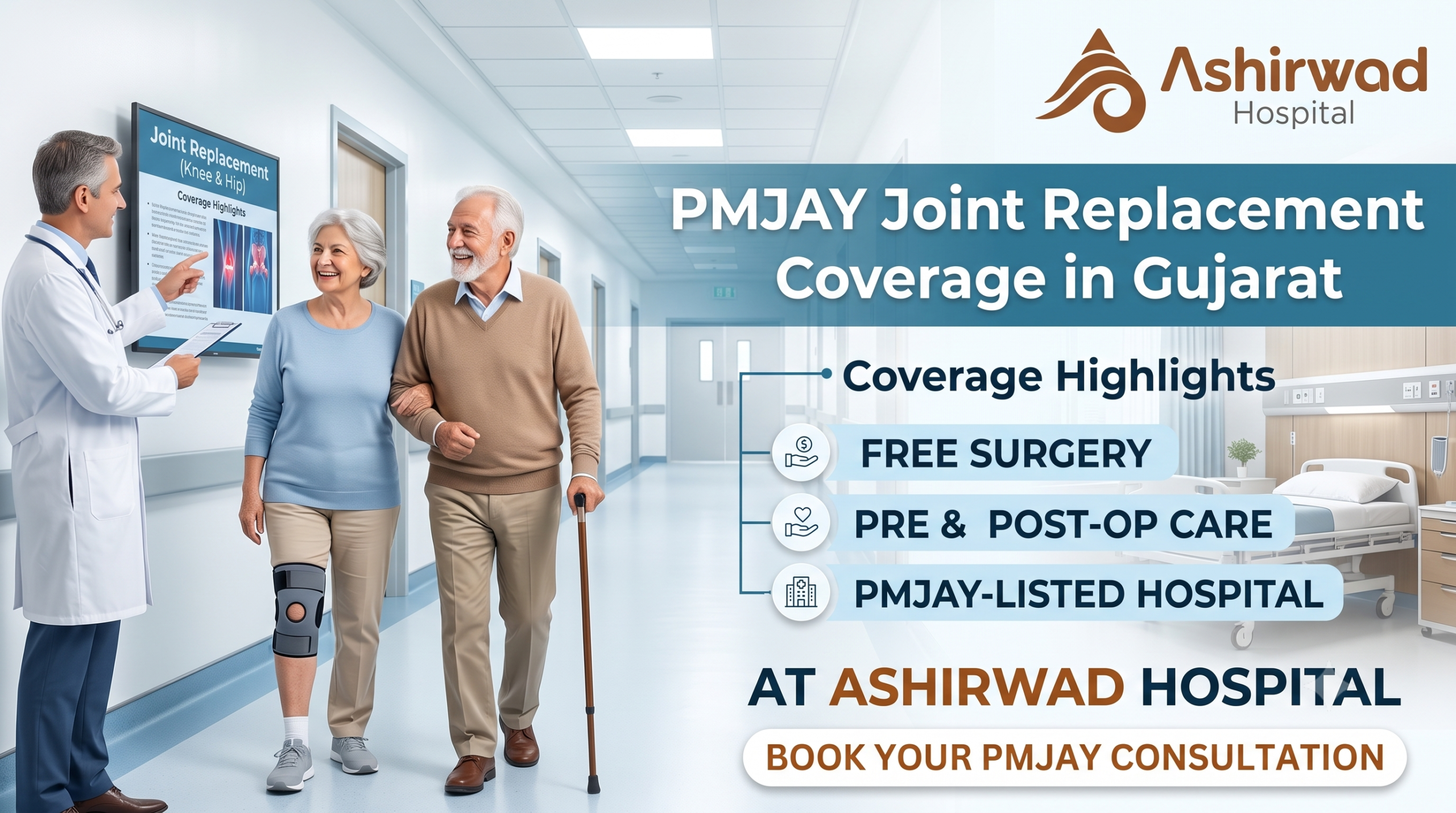
A knee or hip that no longer cooperates changes daily life in small, constant ways — stairs become a negotiation, a walk to the market gets shorter, sleep gets interrupted by pain. For many families in Surat and across Gujarat, the surgery that would fix this has historically felt out of reach because of cost. That gap has narrowed considerably. Between the central PMJAY scheme and Gujarat’s own Mukhyamantri Amrutum framework, joint replacement surgery now sits within reach for a wide band of the population, provided you know which scheme applies to your family, what it actually pays for, and how the approval process works at an empanelled hospital.
This guide walks through PMJAY and government health scheme coverage for knee replacement, hip replacement, and related joint procedures in Gujarat, from the perspective of Ashirwad Hospital Surat, an empanelled orthopaedic centre that processes these approvals regularly for patients from Adajan, Vesu, Piplod, Athwa Gate, Rander, and the wider South Gujarat region including Bharuch, Navsari, and Valsad.
What Is PMJAY and How Does It Work in Gujarat?
Pradhan Mantri Jan Arogya Yojana (PMJAY) is the central government’s flagship health insurance programme, launched in 2018 to give economically weaker households cashless access to secondary and tertiary hospital care. In Gujarat, PMJAY does not run on its own — it operates merged with the state’s earlier Mukhyamantri Amrutum (MA) and MA Vatsalya Yojana schemes, under the combined name PMJAY-MA.
This merger matters because it widened the eligible population beyond the strict central SECC-2011 list to also include additional income categories the Gujarat government had already been covering under MA Yojana. From July 11, 2026, the state doubled the annual family cover from ₹5 lakh to ₹10 lakh, one of the more generous state-adjusted limits in the country, a change expected to benefit roughly 1.78 crore Ayushman card holders across Gujarat, with claims processed through a network of over two thousand government hospitals and nearly 800 private hospitals in the state.
For orthopaedic patients specifically, this shift means the financial ceiling that once forced families to postpone a knee or hip replacement for years is now high enough to comfortably absorb a standard joint replacement package — implant included — at a network hospital like Ashirwad Hospital Surat.
Joint Replacement Procedures Covered Under PMJAY
The PMJAY package master list runs to nearly two thousand procedures, and orthopaedics is one of the more detailed categories within it. For joint replacement specifically, coverage extends to:
- Total Knee Replacement (TKR) — unilateral and bilateral, single sitting or staged
- Partial (unicompartmental) Knee Replacement, for patients with limited joint damage
- Total Hip Replacement (THR) and Partial Hip Replacement
- Revision Knee Replacement and Revision Hip Surgery, for failed or worn-out earlier implants
- Total Shoulder Replacement and Reverse Shoulder Replacement
- Associated hospitalisation costs — pre-operative tests, anaesthesia, implant, operation theatre charges, standard ward stay, and routine post-operative physiotherapy and rehabilitation
Each procedure sits under its own government-negotiated package code with a fixed rate. This is why the surgical plan needs to be documented precisely at the time of pre-authorisation — an incomplete clinical file or the wrong package code is the most common reason approvals get delayed at any hospital, not only in Surat.
PMJAY-MA Coverage Amounts in Gujarat
Families evaluating whether their joint replacement will be fully covered should understand the layered structure of coverage now available in the state.
| Scheme | Coverage per Family / Year | Who It Applies To |
|---|---|---|
| PMJAY-MA (Ayushman Bharat + Mukhyamantri Amrutum) | ₹10 lakh (revised July 2026) | SECC-2011 eligible households, EWS, and MA / MA Vatsalya categories |
| Ayushman Vay Vandana | Additional ₹5 lakh top-up | All senior citizens aged 70 and above, regardless of income |
| Aam Aadmi Bima / state top-up schemes | Up to ₹2 lakh | APL families paying a nominal annual premium, where applicable |
A senior citizen who is already part of a PMJAY-MA family and also crosses 70 years of age effectively receives two layers of cover — the family’s existing limit plus a personal ₹5 lakh top-up under Ayushman Vay Vandana — which is often more than sufficient for a single or even bilateral knee replacement.
Who Is Eligible for PMJAY Joint Replacement Coverage in Gujarat?
Eligibility is assessed at two levels — the central SECC-2011 database and the state’s own MA Yojana income criteria, run in parallel so that a household ruled out by one list can still qualify through the other.
Central PMJAY (SECC-2011) Criteria
- Households without an adult member aged 16 to 59
- Households with no able-bodied adult member and a disabled member
- Manual scavenger families, bonded labourers, and destitute households
- Landless households deriving income from manual casual labour
Gujarat State (MA Yojana) Criteria
- Families holding a valid BPL (Below Poverty Line) card
- Families with annual income up to a defined state threshold, verified through income certificates
- Senior citizens above 70, covered irrespective of income under Ayushman Vay Vandana
Patients unsure which category they fall under can check status directly through the PMJAY Beneficiary Portal, or ask the Pradhan Mantri Arogya Mitra desk at any empanelled hospital, including Ashirwad Hospital Surat, to verify eligibility before the first orthopaedic consultation.
Documents Required for PMJAY Knee and Hip Replacement Approval
Getting pre-authorisation moving quickly comes down to having the right paperwork ready at the first orthopaedic consultation. The typical checklist looks like this:
| Document | Why It Is Needed |
|---|---|
| Ayushman Card / PMJAY-MA e-card | Primary proof of scheme enrollment |
| Aadhaar Card | Identity verification for the beneficiary |
| Ration Card or income proof | Confirms household eligibility category |
| Recent X-ray / MRI of the affected joint | Clinical justification for surgery and correct package selection |
| Referral letter, where applicable | Required for certain package approvals or transfers between hospitals |
| Passport-size photograph | Attached to the hospital’s admission and insurance file |
Ashirwad Hospital Surat’s insurance desk reviews this file before scheduling the surgery date, so any missing document is flagged early rather than on the morning of admission.
How the PMJAY Claim Process Works for Joint Replacement
The workflow for a cashless joint replacement under PMJAY-MA follows a consistent sequence at any empanelled hospital:
- Orthopaedic consultation and diagnosis, with X-ray or MRI confirming the need for replacement surgery
- Verification of the patient’s Ayushman card and eligibility through the hospital’s Arogya Mitra desk
- Selection of the correct package code and submission for pre-authorisation to the state health authority
- Approval, typically within 24 to 48 hours for straightforward cases, longer for revision or complex cases
- Admission, surgery, and hospital stay, billed directly to the scheme with no upfront payment from the family for covered components
- Discharge summary and follow-up physiotherapy schedule, also covered under the package where applicable
Because the entire transaction is cashless at empanelled hospitals, families are not expected to pay and later claim reimbursement — the hospital settles directly with the insurer or trust running the scheme in Gujarat.
What PMJAY Does Not Cover in Joint Replacement Surgery
Setting realistic expectations avoids surprises at billing time. A few areas commonly sit outside the standard PMJAY-MA package:
- Premium or imported implants beyond the specification approved in the package — the price difference is typically payable by the family
- Extended private room upgrades beyond the entitled ward category
- Cosmetic or elective add-ons not linked to the medical necessity of the replacement
- Long-term rehabilitation beyond the standard post-operative physiotherapy window, if extended care is separately recommended
Ashirwad Hospital Surat’s team explains any such gap in writing before surgery, so the decision to opt for a premium implant, for instance, is made with full knowledge of the cost involved.
Why Choose Ashirwad Hospital Surat for PMJAY Joint Replacement
Ashirwad Hospital Surat is empanelled under PMJAY-MA and has an in-house insurance and Arogya Mitra desk dedicated to guiding patients through eligibility checks, documentation, and pre-authorisation, rather than leaving families to navigate government portals alone. For patients travelling in from Bharuch, Navsari, Olpad, Palsana, Hazira, and other parts of South Gujarat, the hospital coordinates the entire admission-to-discharge process, including the standard post-surgery physiotherapy that follows a total or partial knee or hip replacement.
The orthopaedic team led by Dr. Ankit Chaudhari performs both conventional and minimally invasive joint replacement techniques, with pre-surgical planning that factors in the patient’s PMJAY package eligibility from the very first consultation, so there is no late-stage surprise about what is and is not covered.
Signs a Joint Replacement May Be Necessary
Not every case of knee pain that signals you need a replacement needs surgery, and PMJAY coverage only applies once a qualified orthopaedic surgeon confirms replacement is the appropriate treatment. Families weighing whether to start the consultation process often recognise several of these signs together:
- Persistent joint pain that does not improve with rest, medication, or physiotherapy over several months
- Visible swelling or stiffness that limits bending the knee or rotating the hip
- Difficulty climbing stairs, sitting cross-legged, or getting up from a low chair
- Pain that disturbs sleep or worsens with weather changes, common in advanced osteoarthritis
- X-rays showing significant joint space narrowing, bone-on-bone contact, or deformity
- A previous joint replacement that has loosened or worn out after many years of use, which may call for revision surgery
An orthopaedic evaluation at this stage does two things at once — it confirms whether surgery is genuinely needed, and it starts the documentation trail that PMJAY-MA pre-authorisation will eventually require, so the two steps are best handled together rather than one after the other.
PMJAY Versus Private Health Insurance for Joint Replacement
Some families in Gujarat also hold a private mediclaim policy alongside PMJAY eligibility, and it helps to understand how the two interact. PMJAY-MA is a government scheme with fixed package rates, no premium for eligible beneficiaries, and cashless settlement directly between the hospital and the scheme. A private policy, by contrast, usually involves a premium, a sum-insured limit chosen at purchase, and reimbursement or cashless processing through a separate insurer, often with waiting periods for pre-existing joint conditions such as osteoarthritis.
A beneficiary generally cannot claim the same treatment twice under two schemes, but where a family holds both, the hospital’s insurance desk can advise which route gives faster approval and fuller coverage for that specific case, factoring in waiting periods, sub-limits on implant costs, and any exclusions in the private policy that PMJAY does not carry.
Cost of Joint Replacement in Gujarat Without PMJAY Coverage
To appreciate what PMJAY-MA saves a family, it helps to look at the full joint replacement cost breakdown for Surat outside the scheme. A total knee replacement at a private hospital in Gujarat, self-paid, typically runs from ₹1.5 lakh to ₹3 lakh per knee depending on the implant brand, room category, and surgeon’s experience. Bilateral knee replacement, done together, often falls in the ₹3 lakh to ₹5.5 lakh range. Total hip replacement follows a similar band, sometimes higher when a ceramic or advanced-bearing implant is chosen.
For a household earning a modest monthly income, that figure is not a one-time inconvenience — it is a decision that competes with a child’s education, a home loan, or years of savings. This is precisely the gap PMJAY-MA closes for eligible families: the surgery itself, standard implant, hospital stay, and follow-up physiotherapy move from a five- or six-figure out-of-pocket expense to a scheme-funded procedure, with the family paying only for anything genuinely outside the package, such as a premium implant upgrade.
Recovery and Physiotherapy After a PMJAY-Covered Joint Replacement
Coverage under PMJAY does not stop at the operating table. The package includes a defined window of post-operative care, and following the week-by-week knee replacement recovery timeline has a direct bearing on how well the new joint performs over the following years.
- Day 1 to 3 after surgery — supervised movement begins under physiotherapist guidance while the patient is still admitted
- Week 1 to 4 — walking with support progresses to walking with minimal assistance, with wound care and pain management monitored at follow-up visits
- Week 4 to 12 — structured physiotherapy builds joint strength and range of motion, with most patients returning to routine household activity
- Month 3 onward — long-term outcomes depend on maintaining the exercise routine prescribed by the physiotherapy team and attending scheduled follow-up reviews
At Ashirwad Hospital Surat, this recovery pathway is planned before surgery, not improvised afterward, so PMJAY beneficiaries know from day one what the physiotherapy schedule looks like and which parts of it are included under the package.
Common Mistakes Families Make When Applying for PMJAY Coverage
A number of avoidable delays show up repeatedly in PMJAY joint replacement cases, and most come down to timing or paperwork rather than eligibility itself.
- Assuming a family is ineligible without actually checking the Beneficiary Portal or asking the Arogya Mitra desk — many households qualify under the state MA criteria even when they do not meet the central SECC-2011 list
- Arriving for consultation without recent imaging, which pushes the pre-authorisation timeline back by the days it takes to get an X-ray or MRI done and reviewed
- Choosing a hospital that is not empanelled under PMJAY-MA, only to discover mid-process that the claim cannot be processed cashless there
- Not asking upfront about implant options, leading to confusion at billing time if a premium implant was assumed to be fully covered
- Delaying the decision to operate for months or years after diagnosis, during which the joint damage — and the complexity of the eventual surgery — tends to increase
Most of these are solved simply by starting the process early: a consultation, an eligibility check, and a documentation review at Ashirwad Hospital Surat before symptoms force an urgent decision.
Frequently Asked Questions
Is total knee replacement free under PMJAY in Gujarat?
For beneficiaries whose family is enrolled and whose surgery is pre-authorised under the correct package code, the procedure, implant, hospital stay, and standard follow-up are covered up to the annual family limit at empanelled hospitals such as Ashirwad Hospital Surat.
Does PMJAY cover hip replacement as well as knee replacement?
Yes. Both unilateral and bilateral knee replacement, along with total and partial hip replacement, appear as separate package codes under the orthopaedic surgery category of the PMJAY package list.
Can senior citizens above 70 get a second cover if they already have a PMJAY card?
Yes. Under Ayushman Vay Vandana, beneficiaries aged 70 and above receive an additional ₹5 lakh top-up for themselves, on top of any existing family cover under PMJAY-MA.
What happens if my joint replacement needs a premium or imported implant?
Standard PMJAY packages are built around approved implant categories. If a patient chooses a premium implant beyond the package specification, the difference is typically payable out of pocket, and the hospital’s insurance desk explains the exact gap before surgery.
How long does pre-authorisation take before surgery can be scheduled?
Straightforward orthopaedic cases are commonly approved within 24 to 48 hours once documentation is complete, though complex or revision cases may take longer for medical review.
Is bilateral knee replacement covered in a single admission?
Yes, bilateral knee replacement has its own package code and is commonly performed in a single admission for eligible beneficiaries, subject to the treating surgeon’s clinical assessment.
Do I need to visit a government office in Surat to apply, or can the hospital handle it?
The hospital’s Arogya Mitra desk at Ashirwad Hospital Surat can verify eligibility and submit the pre-authorisation directly, so a separate government office visit is generally not required for the surgical approval itself.
Can a family that already used part of its ₹10 lakh limit this year still claim for joint replacement?
Yes, as long as the remaining balance for the year covers the applicable package rate; the ₹10 lakh limit is a family-floater ceiling shared across all members and all covered treatments in that scheme year. You can also read this related guide on Ayushman card total knee replacement coverage in Surat for a package-specific breakdown.
Getting Started
If joint pain has reached the point where daily movement feels limited, the first practical step is an orthopaedic consultation to confirm whether replacement surgery is medically indicated, followed by an eligibility check for PMJAY-MA. Ashirwad Hospital Surat’s Arogya Mitra desk can verify a patient’s Ayushman card status, walk through the required documents, and outline the expected coverage before any commitment is made. Patients from Surat, Bharuch, Navsari, and neighbouring districts can contact Ashirwad Hospital Surat directly to book a consultation and begin the pre-authorisation process.