
Ayushman Card Hospitals for Total Knee Replacement in Surat: Complete Treatment Guide
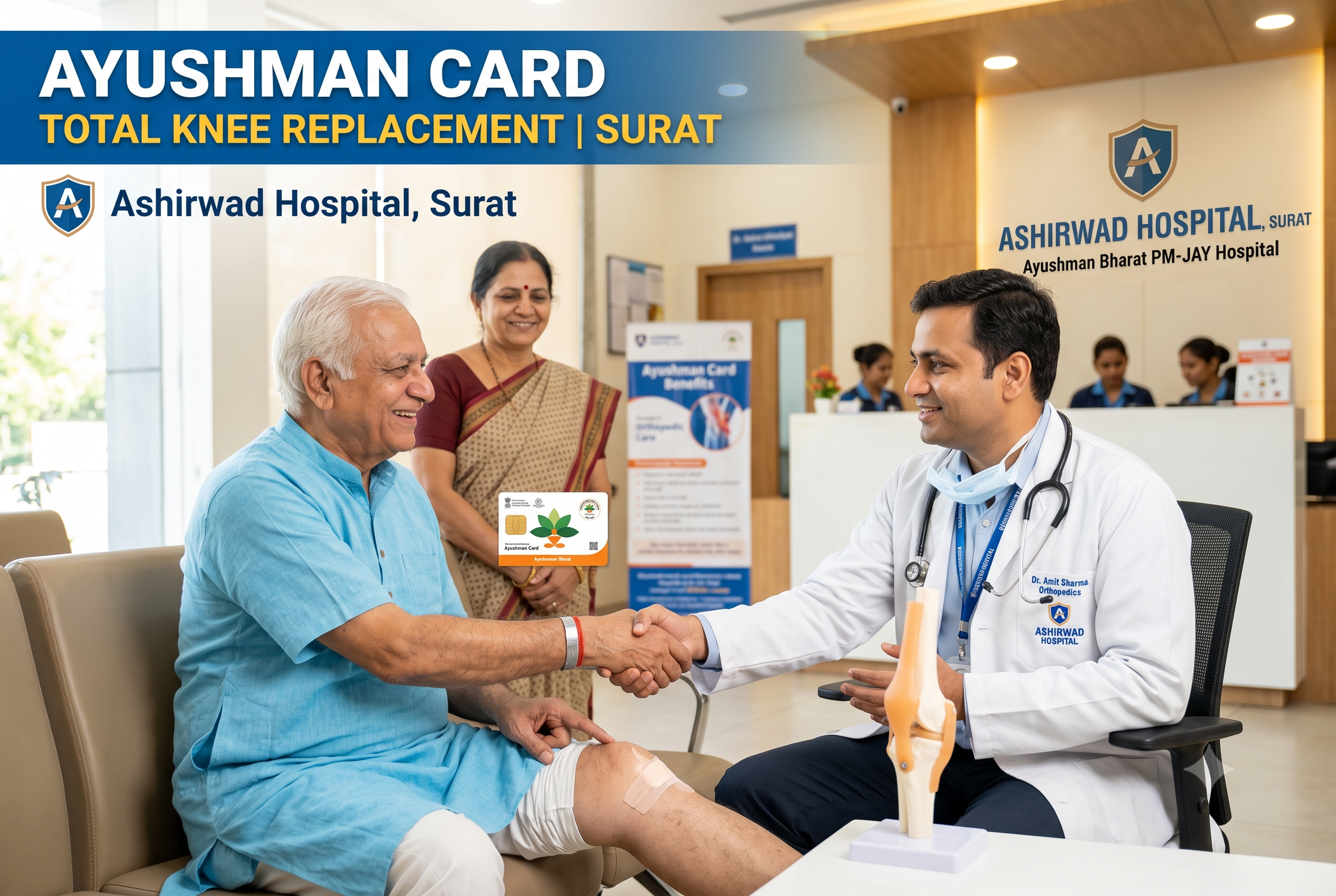
Knee pain from advanced arthritis or joint damage can make even simple daily tasks feel impossible. For many families in Surat, the biggest barrier is not the diagnosis, it is the cost of surgery. Total knee replacement is fully covered under the Ayushman Bharat Pradhan Mantri Jan Arogya Yojana (PMJAY) scheme, and Ashirwad Hospital Surat, led by orthopedic surgeon Dr. Ankit Chaudhari, offers Ayushman card holders a clear, guided path to cashless knee replacement surgery.
This guide covers what the Ayushman card includes, who is eligible, how the cashless process works at Ashirwad Hospital, what the surgery involves, recovery timelines, and the most common questions patients ask before surgery.
What Is the Ayushman Bharat Card and How Does It Help Knee Replacement Patients
The Ayushman Bharat Yojana, also called Pradhan Mantri Jan Arogya Yojana (PM-JAY), is the Government of India’s flagship health insurance scheme. It gives eligible families cashless health coverage of up to Rs 5 lakh per family per year for secondary and tertiary care at empaneled hospitals across the country.
Total Knee Replacement (TKR) is explicitly listed under the scheme’s orthopedic package. A Parliamentary reply given in December 2025 confirmed that TKR surgery is covered under AB-PMJAY, with cashless coverage available through empanelled hospitals nationwide. Coverage has also been expanded to include senior citizens aged 70 and above through the Vay Vandana Card, widening access for elderly knee patients who need this surgery the most.
Under the Ayushman card, the approved package for total knee replacement generally covers:
- Pre-surgery evaluation, X-rays, and blood work
- The knee implant itself
- The surgery and operation theatre charges
- Hospital stay, typically five to seven days
- Post-operative physiotherapy and follow-up care
Patients do not pay out of pocket for any of these components once the hospital’s Ayushman card claim is approved.
For patients who want to understand their full range of orthopedic options before deciding on surgery, our orthopedic diagnosis and treatment page explains how Dr. Ankit Chaudhari evaluates knee pain, joint stiffness, and mobility loss before recommending a surgical or non-surgical path.
Signs That Indicate You May Need Total Knee Replacement
Many patients in Surat delay knee replacement for years, assuming the pain is just part of ageing or worrying about cost. Recognizing the warning signs early helps avoid unnecessary suffering and lets the Ayushman card process begin sooner. Common indicators that replacement surgery is worth discussing include:
- Persistent knee pain that continues even at rest or disturbs sleep at night
- Visible swelling or a feeling of warmth around the knee joint that does not settle with rest
- Stiffness that makes it difficult to bend or straighten the knee fully
- A grinding, clicking, or grating sensation felt during movement
- Reduced walking distance because the knee gives way or feels unstable
- Difficulty climbing stairs, sitting on the floor, or getting up from a chair without support
- Visible bowing or deformity of the leg that has developed gradually over time
- Little to no relief from painkillers, physiotherapy, or knee braces after a reasonable trial period
If any of these symptoms sound familiar, an evaluation through our orthopedic diagnosis and treatment service is the right next step, since a proper assessment is also what the Ayushman card authorization process requires before approving a knee replacement package.
Is Total Knee Replacement Free Under Ayushman Card in Surat
Yes. If a patient holds a valid Ayushman card and the hospital is empaneled under PMJAY, total knee replacement is available at zero out-of-pocket cost, within the approved package rate and the family’s remaining annual coverage limit. Private hospitals typically charge Rs 1.5 lakh to Rs 3 lakh per knee, which is exactly the affordability gap the Ayushman scheme was designed to close for families in cities like Surat.
At Ashirwad Hospital, the team handles the entire eligibility verification and cashless authorization process on the patient’s behalf, so families are not left running between offices while dealing with painful, restricted mobility.
Eligibility and Documents Required for Ayushman Card Knee Replacement in Surat
Before scheduling total knee replacement surgery under Ayushman Bharat, patients in Surat should keep the following ready:
- Valid Ayushman Bharat Card (PMJAY Card) issued in the patient’s name or as part of the eligible family unit
- Aadhaar Card for identity verification
- Ration Card or family ID proof, where applicable
- Recent knee X-rays or MRI reports, if already available, to support the medical assessment
- Referral or prescription notes from a prior doctor consultation, if the patient has one
Eligibility under PM-JAY is based on SECC-2011 socio-economic criteria, and coverage has since been extended to all senior citizens aged 70 and above under the Vay Vandana Card, regardless of prior economic category. Patients unsure of their eligibility can check status through the official Ayushman App using their mobile number, ration card number, or Aadhaar number before visiting the hospital.
If a patient’s knee pain has not yet been formally diagnosed, our orthopedic diagnosis and treatment service is the right starting point, since Ayushman card authorization requires a documented medical assessment before a surgery package can be approved.
What if you do not have an Ayushman card yet? Patients in Surat who are not yet enrolled can apply through the official PM-JAY portal or a nearby Common Service Centre (CSC) with their Aadhaar and ration card. The Ayushman App also allows OTP-based eligibility checking from a mobile phone, after which the card can be downloaded or issued at the hospital itself. The card has no fixed expiry, so this is a one-time process that remains usable for future health needs as well.
Step-by-Step Process for Cashless Total Knee Replacement at Ashirwad Hospital
Ashirwad Hospital Surat has structured the Ayushman card journey into a simple, guided process so patients focus on recovery rather than paperwork.
Step 1: Initial Consultation and Knee Assessment Dr. Ankit Chaudhari examines the knee, reviews existing scans, and determines whether the patient needs total knee replacement or a conservative procedure that could delay or avoid surgery.
Step 2: Ayushman Card Verification The hospital’s Ayushman desk verifies the patient’s card and confirms empanelment eligibility for the knee replacement package.
Step 3: Pre-Authorization Medical documentation, including diagnosis notes and imaging, is submitted for pre-authorization approval under the PMJAY portal.
Step 4: Surgery Scheduling Once approval is confirmed, the surgery date is scheduled and the patient receives pre-operative instructions.
Step 5: Total Knee Replacement Surgery The procedure is performed by Dr. Ankit Chaudhari’s orthopedic team using standard implant protocols covered under the PMJAY package.
Step 6: Hospital Stay and In-House Physiotherapy Patients typically stay five to seven days, during which structured physiotherapy begins to restore early mobility.
Step 7: Discharge and Follow-Up Care Post-discharge medicines, follow-up consultations, and physiotherapy guidance are provided as part of the covered package, supporting the patient through rehabilitation.
Understanding Total Knee Replacement Surgery
Total knee replacement is recommended when advanced osteoarthritis, rheumatoid arthritis, or long-standing joint injury has worn down the cartilage to the point where bones rub directly against each other, causing chronic pain and reduced mobility. During surgery, the damaged surfaces of the femur, tibia, and sometimes the kneecap are replaced with a metal and high-grade plastic implant that recreates natural knee movement.
Patients often ask about the difference between total and partial knee replacement, implant longevity, and whether both knees can be treated in one Ayushman approval cycle. Both knees can be operated on if medically necessary, since coverage applies per family per year rather than per procedure, up to the Rs 5 lakh annual limit.
For patients whose knee pain is at an earlier stage and surgery is not yet necessary, our non-surgical treatments page outlines injection therapies, bracing, and activity modification options that Dr. Ankit Chaudhari uses to manage symptoms before recommending replacement surgery.
Recovery Timeline After Ayushman Card Knee Replacement
Recovery follows a fairly predictable pattern, though pace varies with age, general health, and pre-surgery mobility:
- Days 1 to 7: Hospital stay, wound care, and supervised first steps with a walker under physiotherapist guidance
- Weeks 2 to 6: Basic day-to-day mobility returns, with continued physiotherapy at home or in outpatient sessions
- Months 2 to 3: Most patients resume light household activity and short walks without support
- Months 3 to 6: Full functional recovery, including the ability to climb stairs comfortably and return to most normal activities
Consistent physiotherapy is the single biggest factor in a faster recovery, which is why the Ayushman package’s inclusion of post-operative physiotherapy matters as much as the surgery itself.
Why Choose Ashirwad Hospital for Ayushman Card Knee Replacement in Surat
Families across Surat neighborhoods including Adajan, Vesu, Athwa, Piplod, Katargam, and Varachha choose Ashirwad Hospital for total knee replacement because of a combination of clinical expertise and dedicated Ayushman card support:
- Orthopedic care led directly by Dr. Ankit Chaudhari, with a focus on joint replacement and reconstructive surgery
- A dedicated team that manages the entire Ayushman card verification, documentation, and pre-authorization process
- In-house physiotherapy so recovery does not require patients to travel elsewhere for rehabilitation
- Transparent guidance at every stage, from the first consultation on our orthopedic services page through to full recovery
How Ashirwad Hospital Compares to Other Ayushman-Empaneled Ortho Hospitals in Surat
Surat has several PMJAY-empaneled orthopedic hospitals offering knee replacement, including Shalby Hospital, Aastha Joints Clinic, Sarvam Hospital, Dhruv Orthopaedic Hospital, and Vedaant Orthopedic Hospital. Many of these hospitals publish only general Ayushman eligibility information, without a clear, procedure-specific breakdown of what knee replacement coverage actually involves or what the step-by-step process looks like at their facility.
| Comparison Point | Typical Ortho Hospitals in Surat | Ashirwad Hospital Surat |
|---|---|---|
| Ayushman-specific TKR guidance | Often generic, scheme-level information only | Dedicated, procedure-specific Ayushman card guidance for knee replacement |
| Physiotherapy after discharge | Frequently outsourced or referred elsewhere | In-house physiotherapy included in recovery care |
| Surgeon-led consultation | Varies by hospital, sometimes handled by junior staff | Direct evaluation by Dr. Ankit Chaudhari |
| Pre-surgery non-surgical options | Not always offered before recommending surgery | Conservative and non-surgical options assessed first when appropriate |
| Documentation and approval support | Patient often manages paperwork independently | Hospital team manages verification and pre-authorization |
This gap is exactly where Ashirwad Hospital’s approach adds value: patients get both the medical expertise and the administrative support needed to actually use their Ayushman card smoothly for a procedure as significant as knee replacement.
Frequently Asked Questions
Is total knee replacement covered under the Ayushman card in Surat? Yes, total knee replacement is included in the PMJAY health benefit package and is available cashless at empaneled hospitals in Surat, including Ashirwad Hospital.
How much does total knee replacement cost with an Ayushman card? For eligible cardholders at empaneled hospitals, the approved package cost is covered in full, meaning there is no out-of-pocket expense for the surgery, implant, hospital stay, or physiotherapy.
Can both knees be replaced under one Ayushman card approval? Yes, if medically necessary, both knees can be treated within the same family’s annual Rs 5 lakh coverage limit.
What documents are needed for Ayushman card knee replacement at Ashirwad Hospital? Patients need a valid Ayushman Bharat card, Aadhaar card, ration card where applicable, and any existing knee X-ray or MRI reports.
How long does recovery take after total knee replacement surgery? Basic mobility typically returns within two to six weeks, while full functional recovery usually takes three to six months with consistent physiotherapy.
Is there an age limit for Ayushman card knee replacement coverage? No strict age limit applies for the procedure itself, and coverage has been specifically expanded to include senior citizens aged 70 and above under the Ayushman Vay Vandana Card.
Do I need to pay anything upfront at Ashirwad Hospital if I have an Ayushman card? No, once eligibility is verified and the package is pre-authorized, treatment is cashless, and hospitals are not permitted to charge hidden fees for approved procedures.
To check your eligibility or book a consultation with Dr. Ankit Chaudhari for Ayushman card knee replacement, visit our contact us page, or learn more about our full range of care on the orthopedic services page.