

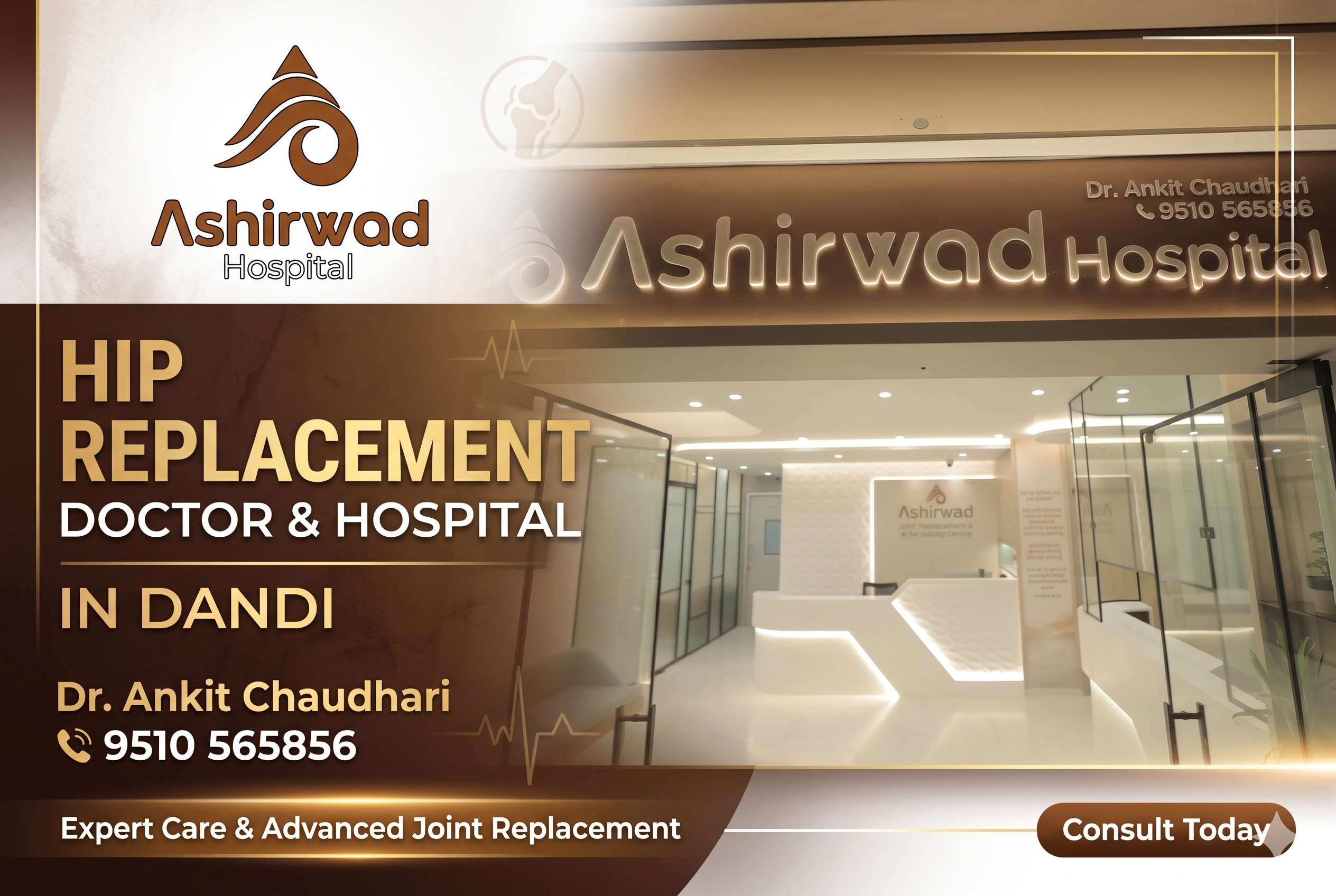
Hip Replacement Doctor Hospital in Dandi, Surat: Complete Patient Guide by Ashirwad Hospital
Living with a painful hip changes how you move through the day. Getting out of bed, tying shoelaces, climbing stairs, or walking to a nearby market starts to feel like a task. If you live in Dandi or a neighbouring part of Surat and you are searching for a trustworthy hip replacement doctor hospital in Dandi, this guide is written for you. It explains who needs hip replacement, how the surgery works, what to expect from your surgeon, how recovery goes, and how to plan costs and insurance.
At Ashirwad Hospital Surat, our orthopedic team led by Dr. Ankit Chaudhari helps patients from Dandi and across South Gujarat return to comfortable movement. Read on, and use this page as a checklist for your first consultation.
Why Dandi Patients Search for a Hip Replacement Doctor and Hospital Nearby
Hip pain rarely arrives overnight. Most people try tablets, oil massage, home remedies, or a few rounds of physiotherapy first. When the pain keeps returning, they start looking for a specialist hip replacement surgeon in Dandi Surat who can explain the real cause and offer honest options.
Residents of Dandi choose a hospital close to home for good reasons. Surgery needs a pre-operative check, scans, admission, follow-up visits and physiotherapy. A hospital that is easy to reach lowers stress for the patient and for the family members who travel with them. A familiar location also helps older patients, who are the largest group needing hip replacement, attend follow-up visits without exhausting journeys.
Ashirwad Hospital is a dedicated orthopedic centre in Surat. Our patients from Dandi often come after they have already seen a general physician or a local clinic. If you have already received an opinion elsewhere, you can also request a second opinion on hip replacement before you decide.
Understanding Hip Joint Problems That Lead to Surgery
The hip is a ball and socket joint. The rounded top of the thigh bone sits inside a cup in the pelvis. Smooth cartilage covers both surfaces so they glide without friction. When that cartilage wears away or the bone is damaged, the joint becomes stiff and painful.
Osteoarthritis of the hip
This is the most common reason for a hip joint replacement. Cartilage thins with age, previous injury, excess body weight or family history. Patients feel groin pain, stiffness in the morning, and difficulty putting on socks. Our arthritis doctors in Surat first assess whether medicines, injections and exercise can help before surgery is discussed.
Avascular necrosis (AVN) of the hip
In AVN, the blood supply to the femoral head is reduced and the bone slowly collapses. It can affect younger adults, including people with a history of long term steroid use, heavy alcohol use or earlier injury. Early stages may respond to joint preserving treatment, while advanced collapse often needs a replacement. You can read more about our AVN hip treatment approach.
Hip fracture in older adults
A fall in an elderly person can break the neck of the thigh bone. This is an emergency. Many such fractures are best treated with a partial or total hip replacement so the patient can stand early and avoid complications of long bed rest. Learn what to do in a hip fracture emergency and why speed matters.
Rheumatoid arthritis and other conditions
Inflammatory arthritis, childhood hip disorders, and old injuries can also damage the joint. A careful history and imaging help your doctor choose the right plan.
Signs You May Need a Hip Replacement Doctor
Not every hip pain needs surgery. Consider booking a consultation if you notice the following:
- Pain in the groin, buttock or thigh that continues even at rest or at night
- Difficulty walking more than a short distance without stopping
- Stiffness that makes dressing, sitting cross legged or using an Indian toilet difficult
- Limping that is getting worse
- Little or no relief from tablets, injections or physiotherapy
- X-ray changes such as narrowed joint space or a collapsed femoral head
If you are unsure, an orthopedic doctor in Dandi can examine you and order the right scans. Our guide to the orthopedic doctor in Dandi explains what the first visit looks like.
Meet Your Hip Replacement Doctor: Dr. Ankit Chaudhari
Choosing the surgeon is the most important decision in the entire journey. Dr. Ankit Chaudhari is the orthopedic surgeon at Ashirwad Hospital Surat who guides patients through hip and knee joint replacement, from the first consultation to the final follow-up.
A good hip replacement doctor does more than operate. He listens to your daily problems, reviews your scans in front of you, explains why surgery is or is not needed, and makes sure you understand the risks. At Ashirwad Hospital, Dr. Ankit Chaudhari follows this approach with every patient.
When you meet your doctor, keep these questions ready:
- What is the exact cause of my hip pain?
- Do I need surgery now, or can I try other treatment first?
- Which implant and surgical approach suit my age and bone quality?
- How many days will I stay in the hospital?
- When can I walk, drive and return to work?
- What is the total estimated cost and what does it include?
A trustworthy doctor will answer these clearly and without pressure. You are also free to bring family members to the consultation.
Why Choose Ashirwad Hospital as Your Hip Replacement Hospital in Dandi Area
Patients looking for a hip replacement hospital in Dandi want more than a building. They want a safe operation theatre, a skilled team, clean wards, clear billing and a physiotherapy plan that starts early. Here is how we approach each of these.
A focused orthopedic hospital
Ashirwad Hospital concentrates on bone, joint, spine and sports injury care. Our team handles joint replacement treatment in Surat every week, so our nurses, anaesthetists and physiotherapists work together on a familiar routine.
Complete range of hip procedures
The right operation depends on the problem. Our hip services include:
- Total hip replacement for advanced arthritis and AVN
- Partial hip replacement (hemiarthroplasty) for selected fractures
- Revision hip surgery for worn or loosened implants
- Emergency fracture surgery for older adults
You can see our full overview on the hip replacement treatment page.
In-house diagnostic support
Accurate planning needs good images. Your surgeon may ask for a digital X-ray of both hips and, where needed, a CT scan evaluation or MRI. These help measure the joint, check bone quality and choose the right implant size.
Rehabilitation from day one
Surgery is only half of the treatment. Our team starts you on gentle movement soon after the operation and continues with a structured plan. Read about our physiotherapy after joint replacement program and our wider orthopedic rehabilitation services.
What Happens During Total Hip Replacement Surgery
Knowing the steps removes much of the fear around surgery. Here is the usual sequence for a primary total hip replacement.
Before surgery
You will have blood tests, an ECG, a chest evaluation, and a review by the anaesthetist. If you have diabetes, high blood pressure, heart disease or thyroid problems, these are brought under control first. Your doctor will review your medicines and tell you which to pause. Any dental or urinary infection is treated beforehand, because infections elsewhere in the body can affect a new implant.
The operation
The surgery is normally done under spinal anaesthesia, sometimes with sedation, or under general anaesthesia when needed. The surgeon removes the damaged femoral head and the worn cartilage from the socket. A metal cup is placed in the pelvis and a stem is fixed in the thigh bone. A smooth ball and liner, made from ceramic, metal or high grade polyethylene depending on your case, creates the new gliding surface.
A primary operation commonly takes one to two hours. Revision or complex cases may take longer.
Choosing an implant
Implant choice is a medical decision. Your surgeon considers your age, activity level, bone strength and body weight. Cemented implants are often suited to older patients with softer bone. Uncemented implants rely on bone growing onto the surface and are often used in younger, active patients. Ceramic bearings are known for low wear, but each option has its own trade offs. Ask your doctor to explain why a specific implant is recommended for you.
Surgical approach
Hip replacement can be done through different approaches, such as posterior, anterolateral or direct anterior. Each has its own advantages and precautions. The best approach is the one your surgeon is trained and comfortable with and that suits your anatomy.
Hip Replacement Recovery: What to Expect After Surgery
Recovery is a team effort between the patient, the surgeon and the physiotherapist. Timelines vary, but the broad stages look like this.
| Stage | What usually happens |
|---|---|
| Day 0 to 2 | Pain control, blood thinner injections, first standing with a walker and physiotherapist |
| Hospital stay | A few days, depending on age and general health |
| Weeks 1 to 2 | Walking with support, wound care, simple exercises, stitch or staple removal |
| Weeks 2 to 6 | Gradual increase in walking, stairs practice, more hip strengthening |
| Weeks 6 to 12 | Most patients walk comfortably and return to light daily work |
| After 3 months | Better strength and endurance, with follow up X-ray |
Your own timeline may be faster or slower. Diabetes, obesity, poor nutrition and delayed physiotherapy can all slow progress.
Practical tips for the first weeks
- Use a raised toilet seat and avoid very low chairs, so the hip is not bent too far
- Follow the movement precautions your surgeon gives you for your specific approach
- Keep the floor free of loose mats and wet patches to prevent falls
- Take blood thinners and antibiotics exactly as advised
- Never skip your exercises, even on days when the hip feels good
- Eat enough protein, since healing needs it
Planning the house in advance makes life easier. Our home preparation checklist for joint surgery recovery applies equally well to hip patients.
Risks and Complications You Should Know About
An honest hip replacement doctor will discuss risks before you sign the consent form. Modern hip replacement is a well established operation with good outcomes for most patients, but no surgery is risk free.
- Infection at the wound or around the implant, which is why sterile theatre practice and antibiotics matter
- Blood clots in the leg veins, reduced with blood thinners, early walking and compression
- Dislocation of the new joint, mostly in the early weeks, reduced by following precautions
- Difference in leg length, which is carefully planned for but sometimes mildly present
- Implant wear or loosening over many years
- Nerve or blood vessel injury, which is uncommon
- Anaesthesia related risks, which depend on your overall health
Tell your doctor about every medicine, allergy and past illness. This makes surgery safer. If an older implant wears out, a revision hip surgery can often restore function.
Hip Replacement Cost in Surat: What Affects the Price
Cost is a major worry for families. Nobody can quote an honest final figure without examining the patient, but you can understand what drives the estimate.
- Implant type: cemented, uncemented, ceramic or special implants differ in price
- Type of surgery: primary, partial or revision procedures cost differently
- Room category: general ward, semi private or private room
- Hospital stay length: longer stays raise the total
- Pre-operative tests and medicines
- Physiotherapy and follow-up visits
- Existing medical conditions that need extra care
For a detailed breakdown, read our guide to hip joint replacement cost in Surat and our wider article on hip replacement surgery cost in India. When you meet the hospital billing team, ask for a written estimate that lists what is included and what is not.
Ayushman Card, PMJAY and Cashless Insurance for Hip Surgery
Many families in Dandi and Surat hold a government scheme card or a private health policy. Always check coverage before admission, so there are no surprises at discharge.
Government schemes. Eligibility and package coverage under PMJAY depend on the scheme rules and hospital empanelment at the time. Read our explanation of PMJAY joint replacement coverage in Gujarat before you apply.
Private insurance. Most policies cover surgery that is medically necessary, subject to waiting periods, sub limits and room rent caps. The process for cashless surgery insurance usually needs pre-authorisation from your insurer, so share your policy details early with the hospital desk.
Documents to keep ready: Aadhaar card, insurance card or policy number, previous prescriptions, X-ray and MRI films, and a list of current medicines.
Non-Surgical Options Before Hip Replacement
A responsible doctor does not push surgery on every patient. In early arthritis, these steps may delay or avoid replacement:
- Weight reduction, which reduces load on the joint
- Physiotherapy for hip and core strength
- Walking aids such as a stick used on the opposite side
- Pain medicines and anti-inflammatory tablets as advised by a doctor
- Selected joint injections in suitable cases
- Treatment of bone weakness, since low bone density raises fracture risk; see our osteoporosis treatment doctors in Surat page
Surgery becomes the right decision when pain, stiffness and loss of walking ability continue despite these efforts.
How to Prepare for Your Hip Replacement
Good preparation improves outcomes. Start a few weeks ahead.
- Control chronic illness. Keep sugar and blood pressure stable.
- Stop smoking and tobacco. It slows bone and wound healing.
- Strengthen your muscles. Your physiotherapist may teach pre-surgery exercises.
- Arrange help at home. Plan for a family member to assist for the first weeks.
- Prepare your home. Remove rugs, add a chair with arms, and set up a bed on the ground floor if possible.
- Pack for the hospital. Loose clothing, non-slip footwear, personal items and all reports.
- Plan your transport. A car with easy entry makes the trip home easier.
Hip Replacement Along with Other Joint Problems
Some patients have hip and knee arthritis together. In such cases the doctor decides which joint to treat first, based on which one limits walking more. If your knee also troubles you, see our page on the knee replacement surgeon in Dandi. Active patients with a sports injury can read about our ACL reconstruction doctor in Dandi.
Patients elsewhere in the city may also read our page for the hip replacement doctor hospital in Adajan.
Frequently Asked Questions About Hip Replacement in Dandi, Surat
Who is the best hip replacement doctor in Dandi, Surat?
The right surgeon depends on your diagnosis and how comfortable you feel with the care team. Dr. Ankit Chaudhari at Ashirwad Hospital Surat treats patients from Dandi who have hip arthritis, AVN and fractures. Book a consultation so he can review your X-rays and explain your options.
How long does a hip replacement surgery take?
A primary total hip replacement usually takes one to two hours in the operating theatre. Preparation, anaesthesia and recovery room time add to this. Complex or revision cases can take longer.
How many days do I stay in the hospital after hip replacement?
Most patients stay a few days, depending on age, other health conditions and how quickly they begin walking with support. Your surgeon confirms the plan after reviewing your health.
When can I walk after a hip replacement?
Many patients stand and take a few steps with a walker and a physiotherapist within a day or two of surgery. Walking without support usually returns over several weeks.
Is hip replacement covered under the Ayushman card or insurance?
Coverage depends on your scheme, policy terms and hospital empanelment. Our team can check eligibility for PMJAY and private cashless insurance before admission.
What is the cost of hip replacement surgery in Surat?
Cost varies with implant type, room category, your health and any extra tests. An exact estimate is given only after consultation and examination.
How long does a hip implant last?
Modern implants often last many years, commonly cited as fifteen to twenty or more. Longevity depends on implant material, body weight, activity level and follow-up care.
Can I sit cross legged or climb stairs after hip replacement?
Stair climbing returns early with support. Sitting cross legged or squatting may be restricted for some time, depending on your approach. Your surgeon will tell you what is safe for you.
Can both hips be replaced together?
In selected patients, both hips can be treated in a planned way, either together or in stages. The decision depends on your age, heart and lung health and overall strength.
When to Call Your Doctor Immediately
Contact your hip replacement doctor or visit the hospital quickly if you notice any of the following after surgery:
- Fever or chills
- Redness, heat or discharge from the wound
- Sudden severe hip pain or inability to bear weight
- Swelling, pain or warmth in the calf, which can signal a clot
- Shortness of breath or chest pain, which needs emergency care
- A hip that looks twisted or a leg that suddenly seems shorter
Book Your Hip Replacement Consultation in Dandi, Surat
You do not have to live with hip pain. A clear diagnosis, an honest explanation and a careful plan can change how you walk, sleep and enjoy time with your family. If you are looking for a hip replacement doctor hospital in Dandi, Ashirwad Hospital Surat offers expert orthopedic care with Dr. Ankit Chaudhari and a supportive team.
Bring your previous reports, X-rays and medicine list to your first visit. Use the contact our team page to book an appointment or ask a question. The earlier you act, the more treatment options you may have.
Disclaimer: This article is for general information and does not replace a personal medical opinion. Treatment decisions should be made after a physical examination and review of your scans by a qualified orthopedic doctor.