
Cashless Health Insurance for Surgery — TPA Network Near Adajan
If you or a family member needs surgery and you’re wondering whether your health insurance will cover it without upfront payment, the short answer is: yes, if you’re treated at a hospital empanelled with your insurer’s TPA network. Ashirwad Hospital, located close to Adajan in Surat, is empanelled with major insurers and Third Party Administrators (TPAs), which means eligible patients can undergo surgery — from joint replacement to trauma care — without paying the bill out of pocket first. This guide walks through exactly how that process works, which TPAs are typically involved, what documents you’ll need, and what to do if a cashless request is turned down.
What Is Cashless Health Insurance for Surgery?
Cashless health insurance for surgery means the hospital bills your insurance company directly, so you don’t hand over cash or a card at admission or discharge for the covered portion of your treatment. The alternative is a reimbursement claim, where you pay the hospital first and then submit bills to your insurer to get the money back later — a process that can take weeks and requires you to have the funds available upfront.
The organisation that sits between you, your insurer, and the hospital is called a TPA, or Third Party Administrator. A TPA’s job is to verify your policy, review the treatment being proposed, approve or query the pre-authorization request, and coordinate the final bill settlement with the hospital once you’re discharged. Some large insurers run this function in-house rather than through a separate TPA, but the workflow a patient experiences is nearly identical either way.
For surgery specifically — as opposed to a same-day outpatient procedure — cashless approval matters even more, because surgical bills are larger and the paperwork is more detailed. A hospital that has an experienced insurance desk and strong TPA relationships can materially shorten the time between “the doctor recommends surgery” and “you’re actually admitted.”
How Cashless Surgery Works at Ashirwad Hospital, Adajan
The cashless process for a planned (non-emergency) surgery generally follows six stages. Knowing them in advance helps you avoid last-minute delays.
Step 1: Consultation and surgical recommendation. Your treating doctor examines you, confirms the diagnosis, and recommends the specific surgical procedure — for example, a total knee replacement or a total hip replacement. At this stage, ask the doctor’s team for a written treatment plan, since the TPA will need this detail for pre-authorization.
Step 2: Insurance verification at the hospital’s insurance desk. You bring your policy details, insurance card, and ID proof to the hospital’s insurance or TPA desk. Staff confirm whether your specific insurer and policy are active in the hospital’s network, and whether the proposed surgery falls within your coverage, sum insured, and any applicable waiting period.
Step 3: Pre-authorization request submitted to the TPA. The hospital fills out a pre-authorization form covering your diagnosis, proposed procedure, estimated cost, and expected length of stay, and submits it to your TPA or insurer, usually electronically.
Step 4: TPA review and approval. The TPA’s medical team reviews the request against your policy terms. For a planned surgery, approval can typically take anywhere from a few hours to one to two working days, though this varies by insurer and how complete the submitted documents are — which is why it’s worth submitting the request a few days before a planned admission date rather than the morning of.
Step 5: Cashless admission. Once approved, you’re admitted without paying the covered portion of the bill upfront. You may still be asked for a refundable deposit or payment for any non-covered items, depending on your policy’s exclusions and sub-limits.
Step 6: Discharge and final bill settlement. At discharge, the hospital sends the final bill to the TPA for settlement. Any charges outside your policy’s coverage — certain consumables, non-medical items, or amounts above a sub-limit — are billed to you directly.
Ashirwad Hospital’s insurance desk handles Steps 2 through 4 alongside the patient, which is often the part people find most confusing when they try to manage it alone.
It helps to separate what’s in your control from what isn’t. You control how early you start the process and how complete your documents are — both of which shorten Step 4. What’s outside your control is the TPA’s internal turnaround time and any additional queries they raise, which is why building in a buffer of a few days between “surgery date agreed with the doctor” and “planned admission date” is a practical habit rather than an overcautious one.
A common question at this stage is what happens to costs that aren’t fully covered. Even with an approved cashless request, most policies apply some combination of room-rent limits, sub-limits on specific implants or procedures, and co-payment percentages for certain age groups or plan types. The hospital’s insurance desk will typically walk you through an estimated cost breakup before admission, so you know in advance what portion, if any, you’re expected to pay directly — this avoids surprises at discharge.
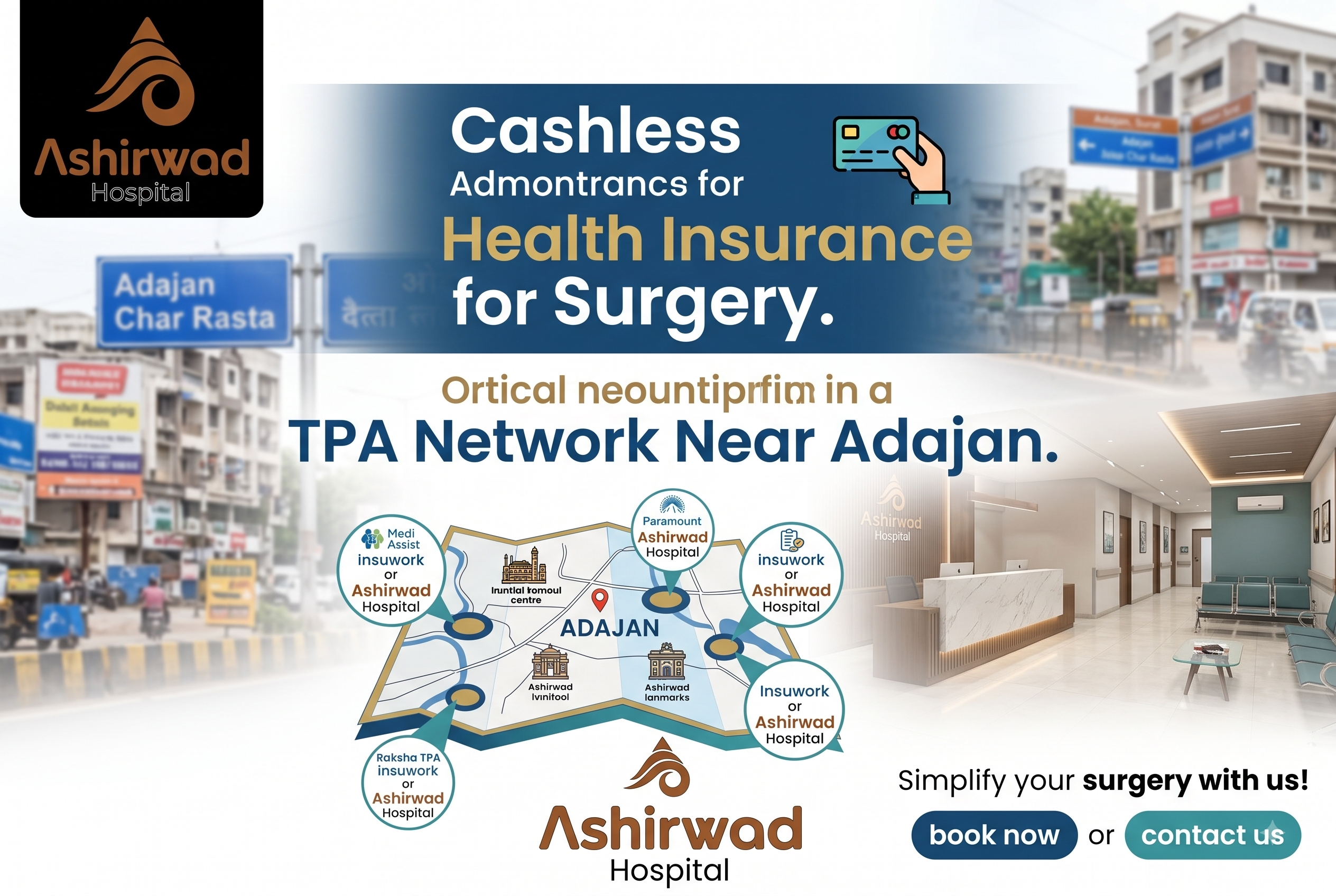
TPA and Insurer Network Near Adajan, Surat
Patients near Adajan, Vesu, City Light, Athwa, and Rander frequently ask which insurers and TPAs a hospital works with before choosing where to get treated. Hospitals typically maintain tie-ups with a mix of general insurers and independent TPAs, and this list is updated periodically as new insurers are added.
| TPA / Insurer | Cashless Typically Available | What to Check |
|---|---|---|
| Star Health & Allied Insurance | Yes | Confirm your specific plan variant is empanelled |
| Care Health Insurance (formerly Religare) | Yes | Check sub-limits on room rent and procedure caps |
| Aditya Birla Health Insurance | Yes | Verify waiting period status for pre-existing conditions |
| ICICI Lombard General Insurance | Yes | Confirm co-payment clauses if any |
| Niva Bupa Health Insurance | Yes | Check if it’s an individual or family floater policy |
| HDFC ERGO General Insurance | Yes | Ask about disease-wise sub-limits for orthopedic surgery |
| The New India Assurance Co. | Yes | Government/PSU plans sometimes need extra documentation |
| TATA AIG General Insurance | Yes | Confirm empanelment for the exact procedure planned |
| Universal Sompo General Insurance | Yes | Check claim intimation timelines |
This table reflects the categories of insurers most hospitals in the Adajan–Surat corridor commonly work with; the exact, current empanelment list can change, so it’s always worth a quick confirmation call to the hospital’s insurance desk with your policy number in hand before you finalize a surgery date. Ashirwad Hospital’s orthopedic services team can verify this alongside your surgical consultation, so you get both answers — clinical and financial — in one visit.
Documents Required for Cashless Surgery Approval
Having these ready before your consultation speeds up the pre-authorization step considerably:
- Health insurance policy card and policy number
- Government-issued photo ID (Aadhaar card, PAN card, driving licence, or passport)
- Doctor’s prescription or written advice recommending the surgery
- Any past medical records or reports related to the condition being treated
- Pre-authorization form (the hospital’s insurance desk provides and helps complete this)
- Details of the policyholder if the patient is a dependent (spouse, child, or parent) rather than the primary policyholder
Missing or incomplete documents are one of the most common reasons pre-authorization gets delayed rather than denied outright, so it’s worth double-checking this list a day or two before your planned admission.
Why Choose Ashirwad Hospital for Cashless Surgery Near Adajan
Location matters more than it might seem when you’re dealing with a scheduled surgery and a recovery period afterward — for follow-up visits, physiotherapy, and any post-operative complications, a hospital that’s a short drive from home in Adajan, Vesu, City Light, or Athwa is genuinely more practical than one across the city.
Beyond proximity, the surgical specialities available matter for how confidently a TPA can process your pre-authorization. Ashirwad Hospital’s surgical program covers spine surgery and back pain treatment, trauma and fracture care, and ACL tear surgery, alongside joint replacement — meaning the insurance desk has direct, repeated experience submitting pre-authorization requests for these exact procedure codes, which tends to reduce back-and-forth queries from the TPA.
A dedicated insurance desk also means someone is following up with the TPA on your behalf while you focus on preparing for surgery, rather than you having to call the insurer yourself between hospital visits.
Cashless vs Reimbursement — What Happens If Cashless Is Denied?
Cashless approval isn’t automatic, and it’s worth understanding upfront why a request might be denied or delayed, rather than being caught off guard:
- Waiting period not completed — many policies exclude certain conditions or surgeries for an initial period (commonly 1–4 years) after the policy starts.
- Policy exclusions — some procedures or conditions are explicitly excluded from a given plan.
- Incomplete or unclear documentation — a vague diagnosis or missing treatment plan can lead the TPA to raise a query, delaying rather than denying approval.
- Hospital not in the insurer’s network — this is why confirming empanelment before admission matters.
- Sum insured exhausted — if previous claims in the policy year have used up your coverage limit.
If cashless approval is denied or you’re treated at a hospital outside your insurer’s network, you’re not without options — you can pay for the treatment yourself and then file a reimbursement claim with your insurer afterward, submitting original bills, discharge summary, and reports. Reimbursement claims typically take longer to settle than cashless ones, but the coverage itself isn’t lost, provided the treatment falls within your policy terms.
Ayushman Bharat and Government Scheme Patients
Patients covered under Ayushman Bharat follow a separate cashless pathway from private TPA insurance — approval runs through the scheme’s own empanelment and authorization system rather than a private TPA. If you’re eligible for both a private policy and Ayushman Bharat, it’s worth discussing with the hospital’s insurance desk which route applies to your specific procedure. Ashirwad Hospital has separate detailed guides for Ayushman card total knee replacement and Ayushman card ACL surgery near Athwa Gate, both close to the Adajan area, if that applies to your situation.
Frequently Asked Questions
Is cashless surgery available near Adajan, Surat? Yes. Ashirwad Hospital, located close to Adajan, is empanelled with several major insurers and TPAs, so eligible patients can have surgery without paying the covered portion upfront, subject to policy terms and pre-authorization approval.
Which TPAs and insurers does Ashirwad Hospital accept for cashless treatment? The hospital works with a range of general insurers and TPAs including Star Health, Care Health Insurance, Aditya Birla Health Insurance, ICICI Lombard, Niva Bupa, HDFC ERGO, and others. Because empanelment lists are updated periodically, confirm your specific insurer with the hospital’s insurance desk before your visit.
How long does TPA approval take before surgery? For a planned, non-emergency surgery, approval commonly takes a few hours to one or two working days once complete documentation is submitted. Submitting your pre-authorization request several days ahead of your planned admission date reduces the risk of delay.
What documents are needed for cashless hospitalization? You’ll need your insurance policy card, a government photo ID, the doctor’s written recommendation for surgery, any relevant past medical records, and a completed pre-authorization form, which the hospital’s insurance desk helps you fill out.
Can cashless requests be denied — and what happens then? Yes, requests can be denied or delayed due to waiting periods, policy exclusions, incomplete documents, or an exhausted sum insured. If denied, you can pay for treatment and file a reimbursement claim with your insurer instead, which is slower but still allows you to recover eligible costs.
Does Ashirwad Hospital accept Ayushman Bharat along with private cashless insurance? Yes, the hospital supports both pathways. Ayushman Bharat cashless approval runs through a separate government scheme process rather than a private TPA, so it’s worth checking with the insurance desk which route fits your situation.
Is there a helpdesk at the hospital to assist with insurance paperwork? Yes. Ashirwad Hospital has a dedicated insurance desk that verifies policy details, prepares and submits pre-authorization forms, and follows up with the TPA on the patient’s behalf through approval, admission, and final bill settlement.
Conclusion
Surgery is stressful enough without also having to navigate insurance paperwork alone. Choosing a hospital near Adajan with an established TPA network and a dedicated insurance desk — like Ashirwad Hospital — removes two of the biggest worries patients face: covering the cost upfront and figuring out which forms go where. Whether you need joint replacement, spine surgery, trauma care, or another procedure, the cashless process is manageable once you know the six steps, have your documents ready, and confirm your insurer’s empanelment in advance. If you’re planning a surgery and want to check your specific policy against the hospital’s current TPA list, contact our team to verify your insurance before your visit.
This article is for general informational purposes and does not guarantee cashless approval, which depends on individual policy terms, TPA review, and insurer decisions. Please verify current empanelment and coverage details directly with the hospital’s insurance desk and your insurer.