
Orthopedic Surgeon Serving Adajan & South Gujarat: Meet Dr. Ankit Chaudhari
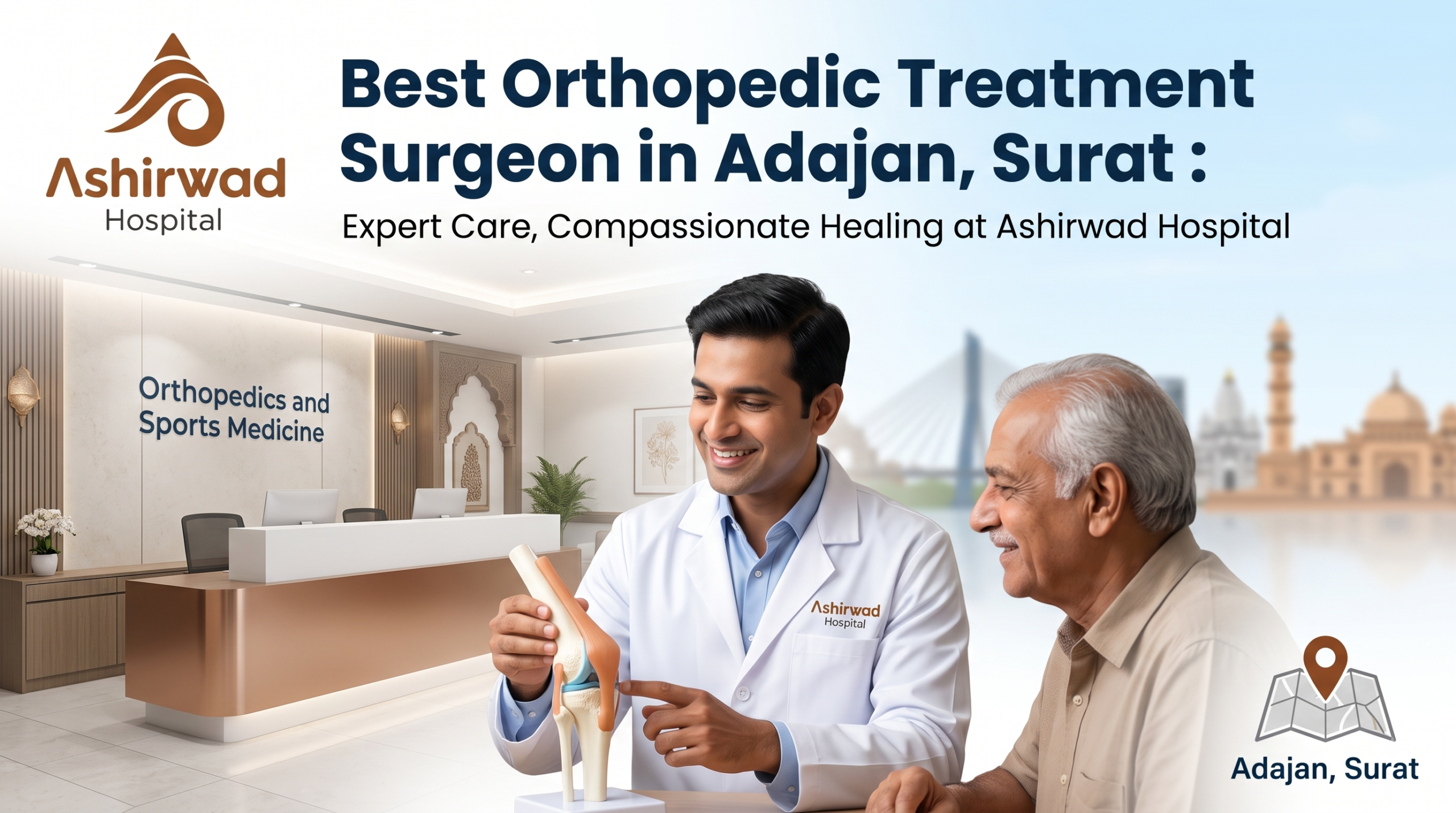
Finding the right orthopedic surgeon usually comes down to two questions: who is actually treating you, and can the hospital behind them handle it if the case turns complicated. This page answers both for Dr. Ankit Chaudhari, orthopedic surgeon at Ashirwad Hospital, Adajan, Surat, and lays out how he works with patients across Adajan and the wider South Gujarat region — what he treats, what a visit costs, what to expect at your first appointment, and how the hospital around him is set up to support that care.
Who Is Dr. Ankit Chaudhari
Dr. Ankit Chaudhari leads the orthopedic department at Ashirwad Hospital in Adajan, seeing patients for joint pain, fractures, sports injuries, spine conditions, and pediatric bone problems. He’s built his practice around a conservative-first philosophy — recommending physiotherapy, injections, or bracing where they’ll genuinely work, and reserving surgery for cases where non-surgical care has been tried or isn’t going to be enough on its own.
That distinction matters more than it sounds. A lot of patients arrive at an orthopedic clinic assuming that pain means surgery, and that assumption alone causes real anxiety before a first visit even happens. Dr. Chaudhari’s approach is to work through the diagnosis first, explain what’s actually happening in plain language, and only bring surgery into the conversation once conservative options have genuinely been weighed — not skipped past.
Patients across Surat, Bharuch, Navsari, Tapi, and Valsad travel to see him, which is part of why the hospital treats out-of-town scheduling and follow-up as a standard part of care rather than an exception. For a patient coming in from Navsari or Valsad, that means the imaging, the consultation, and — if needed — the surgery itself can usually happen without being bounced between multiple facilities in different cities.
Note on credentials: Ashirwad Hospital’s own site describes Dr. Chaudhari as board-certified and fellowship-trained, but doesn’t publish the specific university, degree year, or registration number anywhere public. If you want those details on this page — and for a doctor’s bio, they’re genuinely worth including — send them over and I’ll add a proper credentials block. I’m not filling that in with a guess.
Areas of Focus
Dr. Chaudhari’s practice at Ashirwad Hospital spans the full range of musculoskeletal care, treated under one roof rather than referred out piece by piece.
| Area of expertise | What it covers |
|---|---|
| Joint replacement | Total knee, hip, and shoulder replacement, including revision surgery for failed prior implants |
| Arthroscopy & sports medicine | Minimally invasive HD arthroscopy for ligament and cartilage injuries |
| Spine surgery | Disc herniation, spondylosis, spinal stenosis, and related back conditions |
| Trauma & fracture care | Emergency fixation and complex poly-trauma management |
| Pediatric orthopedics | Clubfoot, developmental hip dysplasia, growth plate injuries, limb deformities |
| Hand & upper limb surgery | Carpal tunnel, tendon repairs, wrist fractures |
| Foot & ankle care | Flat foot, heel pain, ankle instability |
| Orthopedic oncology | Bone tumors and musculoskeletal oncology |
Joint Replacement
Joint replacement tends to be the procedure patients research the most before ever booking a consultation, and for good reason — it’s a bigger decision than most orthopedic treatments. At Ashirwad Hospital, that includes total knee replacement, total hip replacement, and shoulder replacement, along with revision surgery for patients whose earlier implant has failed or worn out. Unilateral and bilateral knee replacement are both offered, using implants chosen for long-term durability rather than the cheapest available option. Full detail on the procedure itself, recovery expectations, and cost is on the joint replacement page.
Arthroscopy & Sports Injuries
For ligament tears, meniscus injuries, and cartilage damage, Dr. Chaudhari uses minimally invasive HD arthroscopy — a keyhole technique that avoids the large incisions of open surgery. In practice, that translates to less post-operative pain, a shorter hospital stay, and a faster return to normal activity, which matters most for athletes and physically active patients trying to get back to their sport rather than just off crutches. Common cases include ACL, PCL, and MCL tears, meniscus injuries, rotator cuff tears, tennis elbow, and ankle ligament sprains. More detail is on the sports injuries page.
Spine Care
Back and neck pain make up a large share of orthopedic visits, and Ashirwad Hospital’s spine program covers both ends of the spectrum — non-surgical management for herniated discs and sciatica through physiotherapy and targeted injections, and surgical options like microdiscectomy, laminectomy, and spinal fusion when the case genuinely calls for it.
Trauma and Fracture Care
Accidents don’t happen on a schedule, and the trauma side of the practice reflects that — fracture fixation, dislocation management, and complex poly-trauma cases are handled with round-the-clock availability rather than standard OPD hours only.
Pediatric Orthopedics
Children’s bones behave differently from adults’ — they’re still growing, which means an untreated deformity or a missed growth-plate injury can leave a lasting effect in a way it wouldn’t for an adult. Dr. Chaudhari treats clubfoot (using the Ponseti casting method), developmental hip dysplasia, flat feet, bow legs and knock knees, adolescent scoliosis, and growth plate fractures.
For the full breakdown of conditions and treatments, see the hospital’s orthopedic services overview and pediatric orthopedics pages.
Why Patients Choose Ashirwad Hospital in Adajan
A surgeon’s outcomes depend heavily on what’s around them — the operating theatre, the imaging on-site, how emergencies get handled. A few concrete points worth knowing:
- Location. The hospital sits at 3rd Floor, Vision Business Hub, opposite Shell Petrol Pump, L.P. Savani Road, Adajan, Surat — an easy reach for patients across Surat’s western belt, and a reasonable drive for patients coming in from further out.
- Regional reach. It also serves patients travelling in from South Gujarat — Navsari, Tapi, and Valsad, so appointments and follow-ups are structured with out-of-town patients in mind, not as an afterthought.
- In-house imaging. Digital X-ray, MRI, and CT scan are all on-site, so most diagnostic workups happen in a single visit rather than sending patients to a separate diagnostic center and back. See the diagnostics & imaging page for the full list, which also includes ultrasound, DEXA bone density scanning, and nerve conduction studies.
- Insurance and cashless facility. The hospital works with major health insurance providers and TPAs for cashless hospitalization — see the cashless surgery insurance page for how the pre-authorization process works.
- One facility, start to finish. Consultation, imaging, surgery (where needed), and post-operative physiotherapy all happen at the same hospital, which cuts down on the coordination burden that comes with juggling multiple providers during recovery.
Consultation Fees and What to Expect at Your First Visit
Ashirwad Hospital publishes its fee structure upfront rather than making patients ask around or guess:
| Service | Approximate fee (INR) |
|---|---|
| Initial OPD consultation | ₹500 – ₹800 |
| Follow-up consultation | ₹300 – ₹500 |
| X-ray (single view) | ₹200 – ₹400 |
| MRI scan (per region) | ₹3,000 – ₹6,000 |
| Physiotherapy session | ₹400 – ₹700 |
| PRP injection therapy | ₹3,000 – ₹6,000 |
| Total knee replacement (package) | ₹1.2 – ₹2.5 lakh |
| Total hip replacement (package) | ₹1.5 – ₹3 lakh |
| Arthroscopy surgery (package) | ₹60,000 – ₹1.5 lakh |
Figures are approximate estimates; exact pricing depends on the case. Full current details are on the orthopedic doctor fees page.
A first visit follows a straightforward sequence. You register at the front desk and fill in a brief medical history form covering symptoms, past conditions, medications, and allergies. A preliminary check follows — weight, blood pressure, and an initial pain assessment — before you actually see Dr. Chaudhari. The consultation itself involves him listening to how your symptoms started and what makes them better or worse, a physical exam checking range of motion, reflexes, muscle strength, and joint stability, and a review of any X-rays or reports you’ve already got. If further imaging is needed, it’s ordered through the in-house diagnostics center, so results are usually available same-day rather than requiring a second visit. Once everything’s in, he explains the diagnosis in plain language, walks through the treatment options — surgical and non-surgical — and lays out the expected recovery timeline and cost before deciding on next steps together.
One practical tip that saves a repeat trip: bring any previous X-rays, MRI films, or medical records to that first appointment. It’s the difference between Dr. Chaudhari working from your actual history and having to start diagnostic testing from zero.
If a joint replacement is on the table, the joint replacement cost breakdown covers pricing in more depth, and signs you need knee replacement is worth reading before that conversation, since it lays out the specific symptoms that typically mark the point where conservative treatment stops being enough.
Surgical vs. Non-Surgical: How the Decision Gets Made
The question patients ask most often, in one form or another, is whether they actually need surgery. Ashirwad Hospital’s approach is conservative-first: non-surgical treatment is tried and given a real chance to work before surgery enters the conversation, not offered as a token gesture on the way to an operating table.
Non-surgical options in active use include physiotherapy and structured exercise programs, PRP (platelet-rich plasma) injections, corticosteroid injections for pain relief, bracing, casting and splinting, hyaluronic acid injections for knee osteoarthritis, and lifestyle and weight management counseling where that’s relevant to the condition. These tend to work well for mild-to-moderate knee osteoarthritis, herniated discs without neurological signs, tennis elbow, plantar fasciitis, and minor ligament sprains.
Surgery becomes the recommendation in a narrower set of cases: severe osteoarthritis where joint space has effectively been lost, a complete ligament tear such as an ACL rupture, spinal cord compression with neurological symptoms, complex or unstable fractures, and bone tumors. Even then, where the procedure allows it, arthroscopic and minimally invasive techniques are used in preference to open surgery to reduce recovery time.
Local Coverage: Adajan and South Gujarat
Because so much of the practice’s patient base comes from outside Surat proper, it’s worth being specific about who this serves. Patients from Adajan itself are the most immediate catchment, but the hospital regularly treats patients from Vesu, Athwa, and other parts of Surat, as well as those travelling in from Bharuch, Navsari, Tapi, and Valsad for both routine consultations and scheduled surgery. For a region where a specialist orthopedic surgeon isn’t always available locally, having imaging, consultation, and surgical care consolidated at one Adajan facility removes a meaningful amount of friction for patients who’d otherwise need to travel to Ahmedabad or Mumbai for the same level of care.
Patient Questions We Hear Often
Do I need a referral to see Dr. Chaudhari?
No. You can book directly without a prior referral from another doctor.
Does he treat both trauma cases and planned joint replacement?
Yes — the practice covers everything from emergency fracture fixation through to elective knee, hip, and shoulder replacement, under the same team.
Is surgery always the recommendation for joint pain?
No. Many conditions — mild-to-moderate arthritis, tennis elbow, minor ligament sprains — respond to physiotherapy, PRP, or bracing first. Surgery is reserved for cases where conservative treatment genuinely won’t be enough, such as severe joint space loss, complete ligament rupture, or neurologically significant spinal compression.
Does the hospital treat children with bone or joint problems?
Yes, through the pediatric orthopedics department — clubfoot, hip dysplasia, growth plate injuries, and related conditions in newborns through adolescents.
How long does recovery take after a knee replacement?
Based on the hospital’s published guidance, most patients can walk with support within 1–2 days after surgery, with full recovery and return to normal activity typically taking 6–12 weeks, supported by in-house physiotherapy through that period.
What does an arthroscopy procedure typically cost?
Approximately ₹60,000 to ₹1.5 lakh, depending on the joint involved and the extent of the procedure — see the arthroscopy & sports injury page for specifics.
Is emergency orthopedic care available outside OPD hours?
Yes. The trauma and fracture care unit operates 24/7 for fractures, dislocations, and accident-related injuries.
For more, see the hospital’s FAQ page.
Book a Consultation
OPD hours run Monday–Saturday, 9:00 AM – 7:00 PM, with Sunday by prior appointment or emergency only. The trauma and fracture care unit operates 24/7 for urgent cases outside those hours. Patients can call +91 95105 65856, email ashirwadhospital@gmail.com, or use the contact page to request an appointment — walk-ins during OPD hours are also accepted. For the wider clinical team beyond Dr. Chaudhari, visit the team page.