

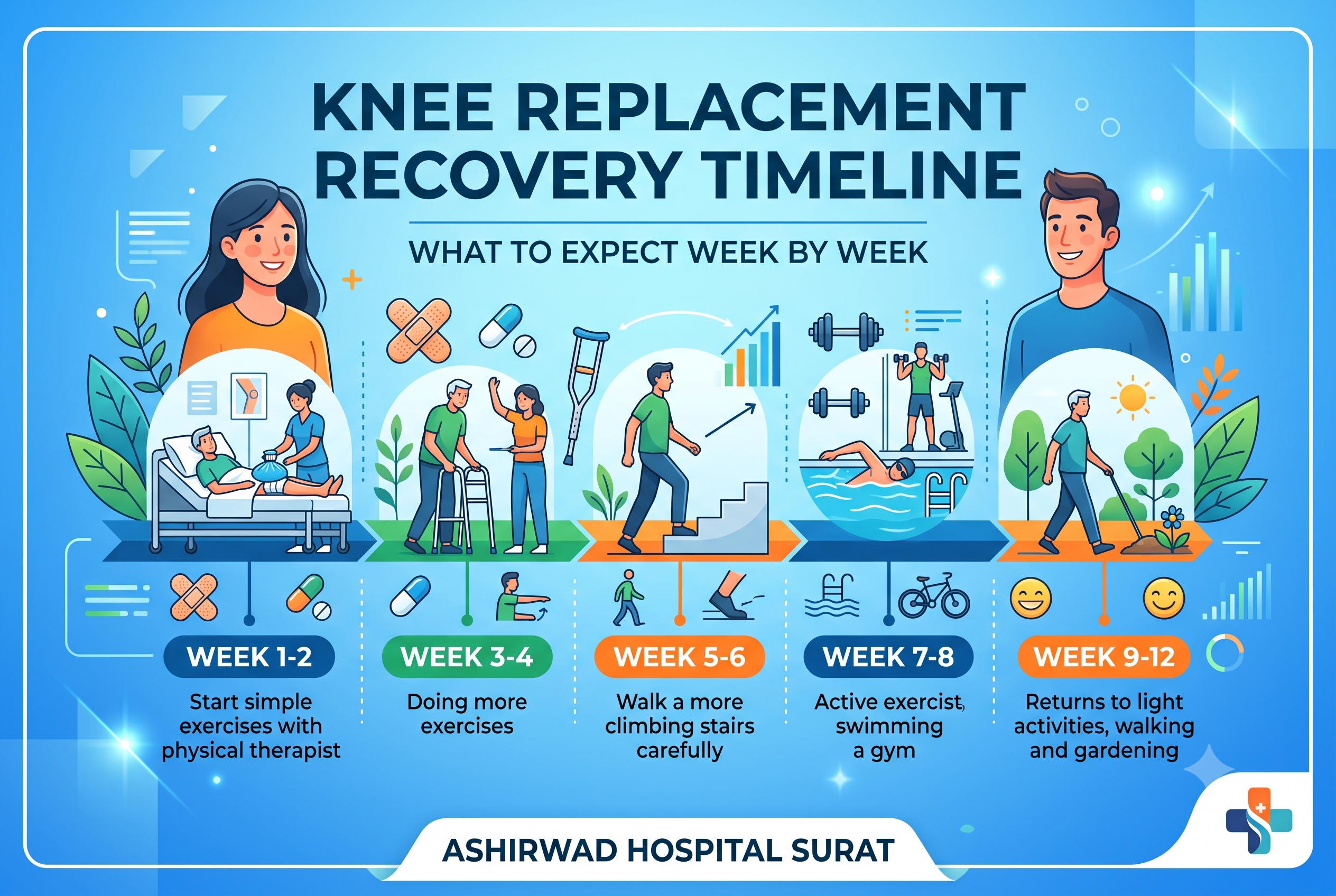
Knee Replacement Recovery Timeline — What to Expect Week by Week
If you or a family member is about to undergo knee replacement surgery in Surat, the question that comes up more than any other isn’t about the operation itself — it’s about what happens afterward. How long before I can walk without support? When can I climb the stairs at home in Adajan or Vesu? When will I stop needing help to get up from a chair?
At Ashirwad Hospital, we’ve walked hundreds of patients across Surat through this exact journey, and one thing we tell every patient before surgery is this: knee replacement recovery is not a single event, it’s a process that unfolds in fairly predictable stages. Knowing what each stage looks like removes a lot of the fear and helps you (and your family caregivers) plan realistically — for time off work, for help at home, and for physiotherapy sessions.
This guide lays out knee replacement recovery in Surat week by week, from the day of surgery through the first year. For a broader overview of the procedure itself — who needs it, how it’s performed, and what the surgery day looks like — see our Total Knee Replacement page.
How Long Does Knee Replacement Recovery Really Take?
Most patients can expect to reach the major milestones — walking without a stick, climbing stairs comfortably, driving again — somewhere between 6 and 12 weeks after surgery. Full recovery, meaning the point where swelling has settled completely and strength has returned close to normal, typically takes anywhere from 6 months to a year. That range feels wide, and it is, because recovery depends on several factors: your age, your weight, how active you were before surgery, whether you have one knee replaced or both at once, and — more than almost anything else — how consistently you follow your physiotherapy plan.
What’s important to understand from the start is that recovery isn’t a straight line. Some days will feel like real progress. Others will feel like you’ve gone backward. Both are completely normal. What matters is the overall trend across each week, not any single day.
With that context in place, here’s what the journey generally looks like.
Day 1 to Day 3: In the Hospital
The first 48 to 72 hours after surgery happen under close observation, either at Ashirwad Hospital or wherever you had your procedure done. Contrary to what many patients in Surat still assume, there is no long bed rest period after a modern knee replacement.
On the day of surgery or the morning after, our physiotherapy team will typically get you standing and taking a few assisted steps with a walker. This early movement isn’t optional — it’s one of the strongest predictors of how well your knee will move in the weeks ahead. Pain and swelling are at their highest during these first few days, and that is expected. Pain is managed with a combination of medication, ice application, and keeping the leg elevated (with the ankle propped, never a pillow directly behind the knee, which can restrict full extension).
During this window, you’ll also begin simple exercises in bed — ankle pumps, gentle knee bends, and quadriceps tightening exercises — designed to keep blood flowing and prevent stiffness before you’ve even left the hospital.
Week 1: Coming Home
Depending on your progress and your surgeon’s assessment, you’ll typically be discharged somewhere between day 2 and day 5. Once home, the focus for week one is simple: manage swelling, protect the wound, and keep up with the exercises your physiotherapist has assigned.
Expect to rely on a walker for most movement during this week. Getting in and out of bed, using the toilet, and moving around the house will feel effortful and slow — this is normal and improves quickly. Icing the knee several times a day and keeping it elevated when resting will help control swelling, which tends to peak around this point.
Sleep is often disrupted in week one because of discomfort in the knee, sometimes described as a tight band or pressure sensation. This too tends to ease as the week progresses. Most patients in Surat are managing basic home mobility — moving between rooms, using a Western-style toilet with a raised seat if needed — by the end of week one.
Week 2: Building Basic Independence
By the second week, many patients notice a real shift. Pain starts to become more manageable, and the swelling — while still present — begins a slow decline. This is often the week your stitches or staples are reviewed and, if needed, removed at a follow-up visit at Ashirwad Hospital.
Physiotherapy intensifies during week two. The goal now is to steadily increase knee flexion (how far the knee bends) and extension (how fully it straightens). Many patients are able to bend the knee to around 90 degrees by this point, which is enough to comfortably sit in a regular chair and manage stairs with support.
Walking distance around the house increases, and some patients begin transitioning from a walker toward a cane, though this varies based on strength and confidence. If your work is largely desk-based, this is roughly the earliest point some patients in Surat start thinking about short work-from-home sessions, though most still need another two to four weeks before returning even to light office duties.
Weeks 3–4: Establishing a Routine
Weeks three and four are where recovery starts to feel less overwhelming and more like a routine. Swelling continues to reduce, though it’s common for the knee to swell somewhat by the end of an active day — this is expected for months, not just weeks.
This is typically the stage where patients graduate from a walker to a cane, and some transition off assistive devices entirely for short indoor distances. Stair climbing, using a railing for support, often becomes manageable around this time. Many patients who drove regularly before surgery are cleared to resume driving somewhere around the four-week mark, though this depends entirely on your surgeon’s assessment of your reflexes, strength, and which knee was operated on (right-knee patients generally need longer before driving).
Physiotherapy sessions during this period shift emphasis from pure range-of-motion work toward building strength in the thigh and hip muscles that support the new joint. This strength work matters as much as flexibility — a knee that bends well but isn’t supported by strong surrounding muscles is more prone to falls and slower long-term progress.
Weeks 5–6: Increasing Strength and Confidence
By weeks five and six, most patients notice a meaningful jump in confidence. Walking distances that felt impossible in week one — a short walk around a housing society compound, for instance — start to feel achievable. Many patients are walking 400 to 500 metres or more with minimal support by this stage.
This is often described by patients as one of the most rewarding stretches of recovery, because the effort of the previous weeks starts to visibly pay off. Balance exercises become a bigger part of physiotherapy now, both to reduce fall risk and to prepare the knee for more demanding daily tasks like getting in and out of a car, or navigating uneven surfaces — something particularly relevant if you live in an older part of Surat with less even pavements or navigate a mix of stairs and ramps at home.
For patients with desk-based jobs, week six is a common — though not universal — point for returning to work, sometimes on a part-time or modified basis initially. Physically demanding jobs, or roles that involve a lot of standing, walking, or lifting, typically require considerably longer, sometimes up to three months.
Weeks 7–8: Extending Range and Endurance
Between weeks seven and eight, the emphasis in physiotherapy usually moves toward endurance and more functional movement patterns — activities that mimic real daily life rather than isolated exercises. Walking distances continue to extend, with many patients managing 800 metres to a kilometre or more, depending on their overall fitness and how consistently they’ve kept up with rehab.
Some soreness after activity is still common at this stage, particularly toward the end of the day, but it should be noticeably milder than in the first month. Range of motion typically continues to improve, and this window matters more than patients often realise: the flexibility you regain in the first three to four months tends to be close to what you’ll keep long-term, because the knee becomes progressively harder to stretch further as tissue heals and settles.
Weeks 9–12: The Rebuilding Phase
The nine-to-twelve week stretch is often where the “rebuilding” phase of recovery really takes shape. Many patients are walking without any support at all by this point, at least for shorter distances, and stair climbing with a railing becomes routine rather than effortful.
This is also the stage where your physiotherapist and surgeon at Ashirwad Hospital will typically start discussing a longer-term strength and conditioning plan — one that goes beyond “recovery” exercises and starts building toward your actual lifestyle goals, whether that’s returning to gardening, temple visits that involve stairs, longer walks, or simply being able to sit cross-legged for short periods (a movement that, realistically, remains difficult or impossible for many knee replacement patients even long-term, and is worth discussing honestly with your surgeon before surgery if it’s a priority for you).
By the twelve-week mark, most patients — though certainly not all — are managing the large majority of daily activities without significant limitation.
Months 3 to 6: Returning to Normal Life
From the third month onward, progress slows down but continues steadily. Most patients report that day-to-day activities — shopping, attending family functions, moving around their home and neighbourhood in Surat — feel largely comfortable by this stage. Swelling, if present at all, tends to be minor and limited to more active days.
This is also the period when many patients feel ready to resume activities they’d paused before surgery, such as light travel, more demanding household tasks, or hobbies that don’t involve high-impact movement. Physically demanding occupations often see workers cleared to return in this window, generally by the three-month mark, though this always depends on individual healing and your surgeon’s clearance.
Months 6 to 12: Full Recovery
The final stretch of recovery, from six months to a year, is about consolidation rather than dramatic change. Strength continues to build gradually, and most of the swelling and stiffness that lingered in earlier months resolves completely for the majority of patients. By the one-year mark, most people describe their knee as simply part of normal life again, rather than something they’re actively “recovering” from.
It’s worth noting that some sensations — mild stiffness after long periods of sitting, occasional awareness of the joint in cold weather, or slight numbness around the scar — can persist beyond a year for some patients and are generally considered normal rather than signs of a problem.
What Actually Determines How Fast You Recover
While the timeline above reflects what most patients experience, a few factors consistently make the biggest difference to how quickly and completely someone recovers:
- Physiotherapy consistency. Patients who complete their prescribed exercises daily, even on days when motivation is low, consistently recover faster and regain more range of motion than those who skip sessions.
- Weight and pre-surgery fitness. Patients who were reasonably active before surgery, and who maintain a healthy weight, tend to place less strain on the new joint during recovery.
- Age and overall health. Conditions like diabetes or cardiovascular issues can extend healing time and require closer monitoring during recovery.
- Home support. Having someone available to help with daily tasks in the first two to three weeks measurably reduces complications and stress, which in turn supports faster physical recovery.
- Following precautions. Avoiding twisting movements, deep squatting, and high-impact activity in the early months protects the implant and the surrounding tissue while it heals.
Warning Signs to Watch For During Recovery
Some discomfort, swelling, and stiffness are a normal part of every stage described above. However, certain symptoms should prompt an immediate call to your surgical team at Ashirwad Hospital rather than waiting for a scheduled follow-up:
- Sudden, significant increase in swelling, redness, or warmth around the knee
- Fever, particularly if it develops several days after surgery
- Calf pain, swelling, or tenderness in the operated leg, which can indicate a blood clot
- Increasing pain that isn’t controlled by prescribed medication
- Any discharge, odour, or opening at the surgical wound
These signs don’t necessarily mean something has gone wrong, but they need to be checked promptly rather than monitored at home.
Recovering From Knee Replacement in Surat — What Makes a Difference Locally
Recovery timelines are broadly similar everywhere, but a few local factors genuinely affect how smoothly recovery goes for patients across Surat. Access to consistent, in-person physiotherapy — rather than relying only on printed exercise sheets — makes a measurable difference in the first six weeks. Housing layout matters too: patients living in buildings without lifts, common across many parts of the city, often need a more deliberate stair-climbing plan built into early physiotherapy. And for patients travelling in from areas like Hazira, Palsana, Olpad, or Ankleshwar for surgery and follow-up, planning the frequency of post-operative visits in advance — rather than figuring it out after discharge — tends to reduce stress considerably.
At Ashirwad Hospital, our post-surgical care includes a structured physiotherapy plan tailored to each patient’s living situation and goals, not just a generic handout, because the details of daily life — the stairs at home, the distance to the nearest market, the kind of toilet in the house — genuinely shape how recovery should be paced.
Final Thoughts
Knee replacement recovery asks for patience more than almost anything else. The timeline above — early mobility in the first week, growing independence through weeks four to eight, and a steady return to normal life over the following months — holds true for most patients, but your own recovery may move faster or slower depending on your circumstances, and that’s not a reason for concern on its own.
If you’re considering knee replacement surgery in Surat, or you’re already scheduled and want a clearer picture of what to expect, our team at Ashirwad Hospital is happy to walk you through a recovery plan built around your specific situation. Visit our Total Knee Replacement page to learn more about the procedure, or contact us to book a consultation.
This article is intended for general educational purposes and does not replace personalised medical advice. Recovery timelines vary from patient to patient. Please consult your surgeon at Ashirwad Hospital about your specific condition and recovery plan.