

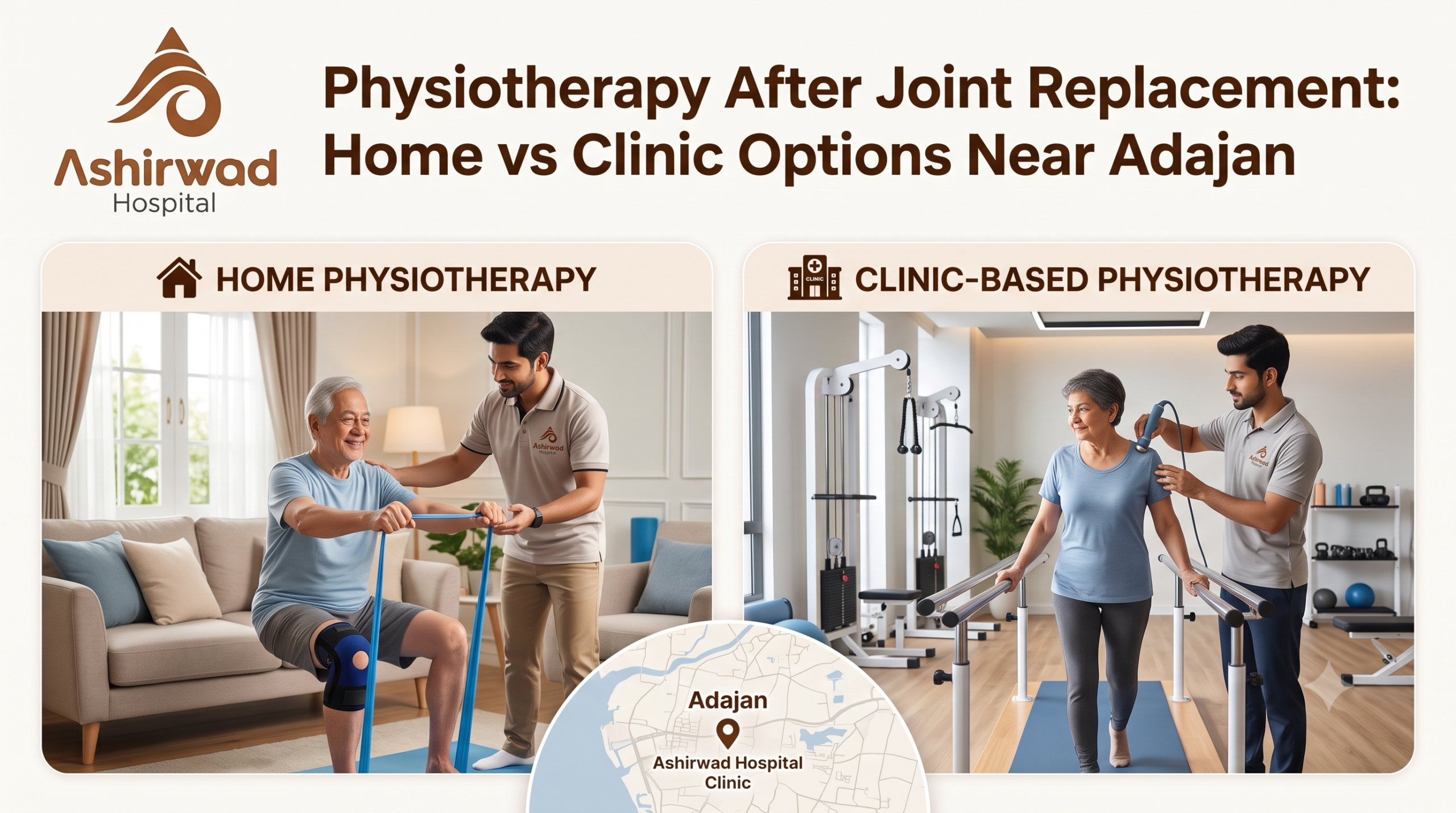
If you or a family member is about to have — or has just had — a knee or hip replacement, one of the most important decisions left after surgery isn’t medical at all. It’s logistical: should physiotherapy happen at home, or at a clinic?
At Ashirwad Hospital, Adajan, we offer both home visit and in-clinic physiotherapy for joint replacement patients across Surat, and in our experience the honest answer is: it depends on which week of recovery you’re in. The right setting for day 3 after surgery is often the wrong setting for week 8. This guide walks through exactly when to choose which, what each option costs in Surat, and what to expect after a knee or hip replacement specifically — so you can make the call with your surgeon instead of guessing.
Why Physiotherapy After Joint Replacement Matters
A new knee or hip joint restores the structure, but it doesn’t restore strength, balance, or range of motion on its own — that’s what physiotherapy after joint replacement is for. Most patients begin gentle movement within 24 to 48 hours of surgery, well before they leave hospital. Skipping or delaying this early mobilisation is one of the most common reasons patients end up with a stiff joint, scar tissue that limits bending, or a slower return to walking unaided.
Physiotherapy after a joint replacement typically progresses through three broad goals: protecting the new joint and controlling swelling in the first couple of weeks, restoring range of motion over the following month, and then rebuilding strength and balance so you can return to normal daily activity — climbing stairs, getting in and out of a car, walking without support. Post-surgery rehabilitation isn’t optional add-on care; for most orthopaedic surgeons, it’s as much a part of the treatment as the operation itself.
Home Physiotherapy vs Clinic Physiotherapy — Quick Comparison
Before deciding, it helps to see the two options side by side. Neither is universally “better” — each wins on different factors, which is exactly why the right choice usually changes as recovery progresses.
| Factor | Home Physiotherapy | Clinic Physiotherapy |
|---|---|---|
| Therapist attention | One-on-one for the full session | One-on-one, but within a shared clinic schedule |
| Equipment access | Portable kit only (bands, TENS, basic tools) | Full range — parallel bars, resistance machines, gait-training aids |
| Travel required | None | Yes — can be difficult in the first 2–3 weeks |
| Infection exposure | Minimal | Present, though clinics follow standard precautions |
| Real-life relevance | Trains on your own stairs, bed, and bathroom | Trains on general clinic setup |
| Best for | First 2–3 weeks after surgery, limited mobility | Progressive strengthening, balance work, plateaued recovery |
| Cost per session (Surat, indicative) | Higher | Lower |
Most patients don’t need to pick one and stick with it. A combination — home visits early, clinic sessions later — is usually the most practical and effective path, and it’s how we structure physiotherapy for most joint replacement patients at Ashirwad Hospital.
Home Physiotherapy After Joint Replacement Near Adajan — Benefits & Limitations
Home physiotherapy means a qualified physiotherapist comes to you, carrying portable equipment such as resistance bands, a TENS unit, and basic mobility aids.
Benefits:
- No travel needed in the days when getting into a car is genuinely painful
- One-on-one attention for the entire session, in a familiar, low-anxiety setting
- Exercises can be practised on your actual stairs, bed height, and bathroom layout — which is exactly where you’ll need to use them
- Lower risk of exposure to other patients or shared waiting areas soon after surgery
- Easier for family caregivers to learn transfers and safe movement techniques directly
Limitations:
- No access to heavier equipment such as parallel bars, resistance machines, or structured gait-training aids
- Progression can plateau once strengthening — rather than mobility — becomes the priority
- Scheduling depends on therapist travel time across Surat, which can limit slot flexibility compared to a walk-in clinic visit
Home physiotherapy near Adajan works best in the first two to three weeks after knee or hip replacement, when the priority is gentle movement, swelling control, and safe day-to-day transfers rather than heavy strengthening.
Clinic-Based Physiotherapy at Ashirwad Hospital, Adajan — Benefits & Limitations
Clinic-based physiotherapy takes place at our facility in Adajan, where the full range of rehabilitation equipment and structured supervision is available.
Benefits:
- Access to equipment that simply doesn’t travel — parallel bars, resistance machines, structured gait-training setups
- Closer supervision during more complex or higher-load exercises, reducing the risk of poor technique
- Physiotherapy delivered as part of one continuous care plan through orthopedic rehabilitation at Ashirwad Hospital, alongside your surgeon
- A structured environment built specifically for rehabilitation, rather than working around a living room
Limitations:
- Requires travel, which can be genuinely difficult in the first couple of weeks post-surgery
- Fixed clinic hours, versus the flexibility of a home visit slot
- Less useful for practising the exact stair height or bathroom layout you’ll face at home
Clinic physiotherapy near Adajan becomes the stronger option from roughly week four or five onward, once the focus shifts from gentle mobility to progressive strengthening and balance training.
Recovery Phase by Phase — When to Choose Home vs Clinic
Rather than treating “home vs clinic” as a one-time decision, it helps to map it against your actual recovery timeline after joint replacement.
| Recovery Phase | Typical Timing | Recommended Setting | Focus |
|---|---|---|---|
| Protection phase | Days 0–14 | Home | Pain and swelling control, gentle range-of-motion exercises, safe transfers in and out of bed |
| Mobility phase | Weeks 2–5 | Home, transitioning to hybrid | Restoring range of motion, walking indoors with support, reducing dependence on aids |
| Strengthening phase | Weeks 5–10 | Clinic (or hybrid) | Progressive loading, muscle strengthening, correcting compensatory movement patterns |
| Function phase | Weeks 10+ | Clinic, then home maintenance | Balance, stamina, return to normal daily activity and, where relevant, driving or work |
For a fuller breakdown of what recovery looks like week by week, see our knee replacement recovery timeline.
Physiotherapy After Knee Replacement — What to Expect
Physiotherapy after knee replacement in Surat typically starts with gentle bending and straightening exercises within the first day or two, aimed at preventing stiffness and encouraging blood flow. Walking with a frame or crutches usually begins early as well, progressing to a stick and then unaided walking as confidence and strength return.
Most patients attend physiotherapy two to three times a week in the first several weeks, alongside daily home exercises, with frequency gradually reducing as flexibility and strength improve. Strengthening work — targeting the muscles around the knee that support the new joint — typically becomes the main focus from around week four or five onward, which is also when many patients are ready to shift from home sessions to clinic-based rehabilitation.
The technique used during surgery can also influence how recovery progresses; if you’re weighing surgical approach as well as rehab setting, our guide on robotic vs conventional knee replacement covers what South Gujarat patients commonly ask. For details on the procedure itself, see total knee replacement at Ashirwad Hospital.
Physiotherapy After Hip Replacement — What to Expect
Physiotherapy after hip replacement in Surat carries an added consideration: hip precautions — specific movements and positions to avoid in the early weeks to protect the new joint. This is precisely where home physiotherapy has a genuine clinical advantage, because a therapist can train you on your actual bed height, chair height, and toilet setup, rather than a generic clinic equivalent.
Early sessions focus on safe transfers (bed to chair, sitting to standing) and short supported walks, with gait training and balance work increasing over the following weeks. As with knee replacement, most patients begin shifting toward clinic-based sessions once the emphasis moves from safe movement to building strength and stamina. Full procedure details are available on our total hip replacement page.
Cost of Physiotherapy After Joint Replacement in Surat — Home vs Clinic
Physiotherapy cost is one of the most common questions we get from patients near Adajan planning their recovery budget. Figures below are indicative — please confirm exact pricing at your consultation, as they depend on the joint involved, session frequency, and individual recovery plan.
| Home Visit (per session) | Clinic Session | |
|---|---|---|
| Indicative cost | Higher, reflects therapist travel time | Lower |
| Typical frequency | Daily to alternate-day in weeks 0–2 | 2–3 times/week from week 3 onward |
| Hidden costs to consider | None — therapist travels to you | Transport, and possibly an attendant’s time |
When you factor in transport and an accompanying family member’s time, the real difference between home and clinic costs is often smaller than the per-session price alone suggests — which is one reason a hybrid plan, rather than an all-or-nothing choice, tends to work out most practically. For the full picture of what joint replacement itself costs in Surat, see our joint replacement cost breakdown.
Physiotherapy Near Adajan — Areas Ashirwad Hospital Covers
Ashirwad Hospital’s physiotherapy team provides both home-visit and in-clinic sessions for patients in and around Adajan, along with nearby Surat localities. Our clinic-based physiotherapy is available at our Adajan facility for patients ready to travel, while home visits are arranged for those in the early recovery window or with limited mobility. If you’re weighing your surgeon and hospital options in the area first, see our page on orthopedic care near Adajan and finding the right knee replacement doctor near Adajan.
Warning Signs You Need Clinic Supervision, Not Just Home Exercises
Home-based recovery is safe and effective for most patients, but certain signs mean it’s time to involve your surgeon or move to clinic-based supervision rather than continuing home exercises alone:
- Pain that is increasing session over session, rather than gradually settling
- No measurable improvement in movement or strength after two or more weeks
- New numbness, tingling, or weakness that wasn’t present before
- A joint that becomes hot, red, or noticeably more swollen
- Fever, or pain that wakes you at night
If any of these occur, contact your surgeon or hospital promptly rather than waiting for your next scheduled physiotherapy session.
Why Choose Ashirwad Hospital for Post-Joint-Replacement Physiotherapy
Because your physiotherapy is planned alongside the same team that performed your surgery, your recovery plan reflects your specific procedure rather than a generic protocol. We also support patients through the practical side of recovery — including cashless surgery and insurance support near Adajan — so that continuity of care doesn’t stop at discharge. To learn more about our hospital and team, visit our About Us page.
Frequently Asked Questions
Which is better after knee replacement — home or clinic physiotherapy? Home is generally better for the first two to three weeks, when travel is difficult and the priority is gentle movement and swelling control. Clinic-based physiotherapy becomes more valuable from around week four or five, once strengthening and balance work take priority.
When should I switch from home to clinic physiotherapy? Most patients transition once they can walk short distances with reduced support and are ready for progressive strengthening — typically around weeks four to six, though this varies by individual and by joint.
How soon after surgery does physiotherapy start? Most patients begin gentle physiotherapy within 24 to 48 hours of surgery, often while still in hospital.
Is home physiotherapy as effective as clinic physiotherapy? For early-stage recovery, yes — the priority in that phase is movement and safety, which doesn’t require specialised equipment. Later-stage strengthening generally benefits from clinic equipment and supervision.
Do you provide physiotherapy near Adajan? Yes. Ashirwad Hospital offers both home-visit and clinic-based physiotherapy for patients in Adajan and nearby Surat areas.
How much does physiotherapy after joint replacement cost in Surat? Costs vary by session type, frequency, and joint involved. Home visits typically cost more per session than clinic visits once travel time is factored in, though total costs including transport are often closer than they first appear. Confirm exact pricing at your consultation.
Can a physiotherapist bring equipment to my home? Yes — portable equipment such as resistance bands and TENS units can be brought to home sessions. Larger equipment such as parallel bars or resistance machines is only available in-clinic.
How long does physiotherapy continue after joint replacement? Structured physiotherapy typically continues for six to twelve weeks, with home exercises often continuing beyond that to maintain long-term mobility.
Book Your Physiotherapy Assessment at Ashirwad Hospital, Adajan
Whether you’re planning ahead for an upcoming joint replacement or are already in recovery and unsure whether to continue at home or move to clinic sessions, our team can assess your progress and recommend the right next step. Contact Ashirwad Hospital to book a physiotherapy assessment near Adajan.