
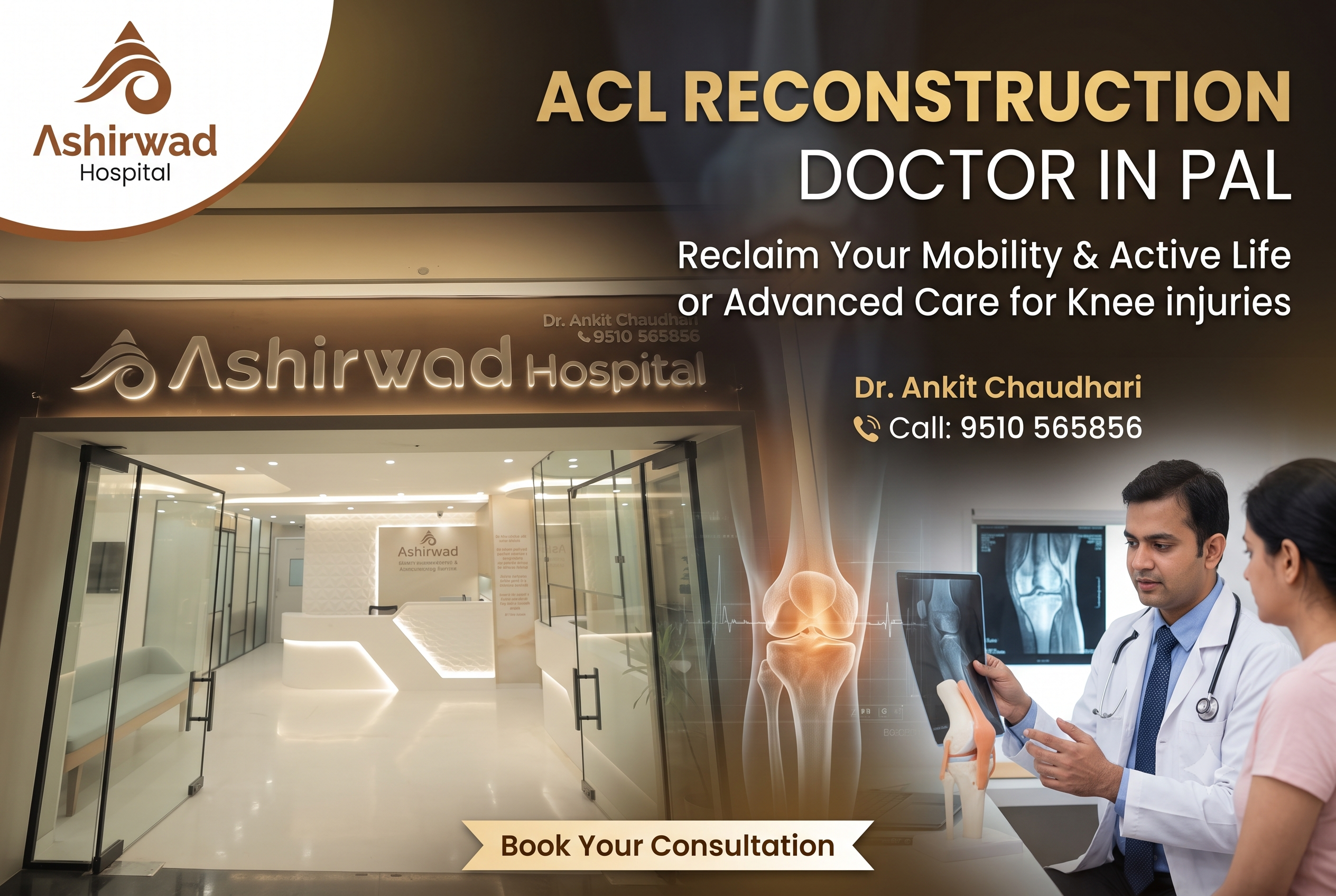
A sudden twist on the football ground, a bad landing during a cricket match, a slip on a wet road near Pal Gam, or a two-wheeler fall on the Pal-Hazira road. Any of these can end with a loud pop in the knee, quick swelling and a feeling that the joint will give way. If this sounds familiar, you are probably searching for an ACL reconstruction doctor in Pal who can explain what has happened and what to do next.
This guide is written for patients and families from Pal, Adajan, Rander, Hazira, Piplod, Katargam and nearby parts of South Gujarat. It explains the ACL, how a tear is diagnosed, when an ACL reconstruction surgeon advises surgery, how arthroscopic ACL reconstruction is performed, what recovery looks like, and how to choose the right orthopedic hospital in Pal, Surat for your knee. It is based on the approach followed by Dr. Ankit Chaudhari and the orthopedic team at Ashirwad Hospital Surat.
What Is the ACL and Why Does Its Tear Matter?
The anterior cruciate ligament, or ACL, is a strong band of tissue inside the knee. It connects the thigh bone (femur) to the shin bone (tibia) and works like a stabilizing rope. It stops the shin bone from sliding forward and controls the rotation of the knee when you pivot, cut, jump or land.
When the ACL tears, the knee loses this control. Walking in a straight line may feel almost normal after a few weeks, but the moment you turn quickly, climb stairs on an uneven surface or run, the knee may buckle. Repeated episodes of giving way can damage the cushioning cartilage and the meniscus, which is why an early visit to a knee ligament doctor is far better than waiting for years.
Common Symptoms of an ACL Tear
Many patients describe the injury in nearly the same way. Look out for the following signs:
- A popping sound or sensation at the time of injury
- Rapid swelling within a few hours
- Pain on the outer or inner side of the knee, or deep inside it
- A feeling that the knee is unstable or “giving way”
- Difficulty in fully straightening or bending the knee
- Trouble walking down stairs or on slopes
- Fear of twisting or pivoting on the injured leg
If you notice these symptoms, avoid forcing the knee back to sport. Use a knee support, rest the leg and consult an orthopedic doctor in Pal the same week. A good early assessment protects the other structures of the knee.
How an ACL Reconstruction Doctor in Pal Diagnoses the Injury
Diagnosis begins with a careful conversation. Your doctor asks how the injury happened, which sport or activity was involved, whether you heard a pop, and how the knee behaves now. Then comes a hands-on examination.
Clinical Tests
Specific bedside tests such as the Lachman test, anterior drawer test and pivot shift test help the surgeon judge how much the shin bone slides forward and rotates. An experienced ACL tear doctor can often form a strong opinion from these tests alone.
X-Ray and MRI
An X-ray rules out fractures and shows the bone alignment. An MRI scan confirms whether the ligament is partially or completely torn and shows damage to the meniscus, cartilage and other ligaments. If you need imaging, you can learn about the facilities on our diagnostics and imaging page. In complex injuries with bone involvement, a CT scan evaluation in Surat may also be advised.
Grades of ACL Injury
- Grade 1: a mild sprain where the ligament is stretched but stable
- Grade 2: a partial tear with some looseness
- Grade 3: a complete tear with clear instability
Most patients who need surgery have a complete tear. To understand the condition in more depth, read our page on ACL tear surgery in Surat.
Does Every ACL Tear Need Surgery?
No. This is an important point, and an honest orthopedic surgeon in Pal will tell you so. The decision depends on your age, your activity level, how unstable the knee feels and whether other structures are injured.
When Non-Surgical Treatment Can Work
- A partial tear with a stable knee
- Older patients with low physical demands
- Patients who do not play pivoting sports and have no giving way episodes
- Patients who respond well to structured physiotherapy and bracing
Non-surgical care includes rest, ice, a hinged brace if needed, strengthening of the thigh and hip muscles, balance training and activity modification.
When ACL Reconstruction Is Usually Recommended
- A complete ACL tear with repeated giving way
- Young and active patients who want to return to sport
- An ACL tear along with a meniscus tear or other ligament injury
- Occupations that demand heavy running, climbing or turning
- Failed conservative treatment, where the knee stays unstable after rehabilitation
An ACL cannot heal by itself when it is completely torn, because it lies inside the joint where blood supply is poor. That is why reconstruction replaces the torn ligament with a graft instead of stitching it.
What Is ACL Reconstruction Surgery?
ACL reconstruction is a keyhole procedure in which the damaged ligament is removed and a new tendon graft is placed in the same position. The graft acts as a scaffold. Over the following months the body gradually incorporates it into the bone tunnels and strengthens it.
Because the surgery is done through small cuts using a camera, it is a form of arthroscopic knee ligament surgery. Our page on minimally invasive HD arthroscopy explains how high definition visualization helps the surgeon work with precision and protect healthy tissue. The wider field is covered under arthroscopy and sports injury care.
Graft Options Your Surgeon May Discuss
Choosing the graft is a joint decision between you and your ACL reconstruction surgeon. The common options are:
- Hamstring tendon graft: taken from the back of your thigh through a small incision. Widely used and generally associated with less pain at the front of the knee.
- Bone-patellar tendon-bone graft: taken from the kneecap tendon with small bone blocks. Often considered for high-demand athletes because the bone heals to bone.
- Quadriceps tendon graft: a thick graft that is gaining popularity for both primary and revision surgery.
- Allograft: tissue from a donor, sometimes considered in older patients or in multi-ligament injuries.
No single graft is best for everyone. Your age, sport, body build, previous surgeries and personal goals decide the best choice.
Step-by-Step: What Happens During ACL Surgery
Knowing the process removes much of the fear. Here is how a typical ACL surgery in Pal, Surat journey unfolds at our hospital.
- Consultation and planning: examination, MRI review and a frank discussion of options.
- Pre-operative checks: routine blood tests, anesthesia fitness evaluation and instructions on fasting and medicines.
- Anesthesia: usually spinal or general anesthesia, chosen by the anesthetist after assessment.
- Diagnostic arthroscopy: a small camera examines the entire joint, and any meniscus or cartilage injury is treated in the same sitting.
- Graft preparation: the tendon is harvested and prepared to the right size.
- Tunnel creation and graft fixation: precise tunnels are made in the thigh and shin bone and the graft is secured with modern fixation devices.
- Closure and dressing: small incisions are closed and a dressing and support are applied.
- Early mobilization: most patients are encouraged to stand and begin gentle movements soon after surgery under supervision.
The operating time and hospital stay vary with the complexity of the injury. Your surgeon will give you a specific estimate after examination.
Associated Injuries Treated Together
An ACL tear rarely occurs alone. Many patients also have a torn meniscus or damaged cartilage. These can often be handled in the same surgery. You can read about meniscus repair surgery hospitals in Surat, PCL reconstruction and repair and cartilage surgery doctors in Surat if your scan shows additional damage. For a broader overview of soft tissue procedures, see our ligament and tendon repair section.
Why Patients in Pal Choose Ashirwad Hospital for ACL Reconstruction
When you search for the best ACL reconstruction doctor near Pal, the name on the board matters less than the quality of the process behind it. Here is what patients should look for, and how Ashirwad Hospital approaches each point.
Focused Orthopedic Expertise
Dr. Ankit Chaudhari is an orthopedic surgeon at Ashirwad Hospital Surat whose practice covers joint replacement, arthroscopy, sports injuries and trauma. A surgeon who handles knee problems every day builds the pattern recognition that helps in planning a safe and precise ACL surgery. If you would like to know about consultation details, see the page on the orthopedic doctor near Surat with fees.
A Hospital Built Around Bone and Joint Care
As a dedicated orthopedic hospital in Surat, Ashirwad Hospital brings the operation theatre, imaging, nursing, physiotherapy and rehabilitation under one roof. This reduces delays and gives you a single team that knows your case from the first visit to the final follow-up. Local patients can also read our guide to the best orthopedic hospital and doctor in Pal, Surat.
Honest, Evidence-Based Advice
Not every torn ligament needs a knife. We explain the benefits and limits of both surgical and non-surgical care so that you decide with full information. If you have already been advised surgery elsewhere, our page on second opinion for knee and hip surgery in Surat explains how we review your reports and scans.
Easy Access From Pal and Nearby Areas
Patients from Pal, Adajan, Rander, Piplod, Hazira, Olpad and Kamrej regularly visit Ashirwad Hospital. Residents of surrounding areas can also find local guidance through our pages for Rander and Olpad.
ACL Surgery Cost in Surat: What Decides the Price?
Patients often ask for the exact cost on the first call. A responsible ACL reconstruction doctor in Pal cannot quote a final figure without examining the knee and reviewing the MRI, because the total depends on several factors:
- The type of graft and its size
- The fixation devices and implants used
- Whether a meniscus, cartilage or other ligament repair is needed along with the ACL
- The type of anesthesia and the room category
- The length of the hospital stay
- Medicines, investigations and the rehabilitation plan
- Insurance, cashless approval or government scheme eligibility
Ask for a written estimate that clearly lists what is included and what is not. A transparent hospital will never hide the pre-operative tests, follow-up visits or physiotherapy from the plan.
Insurance, Cashless and Ayushman Card Support
Many families worry that surgery will strain their savings. Depending on your policy or scheme eligibility, cashless treatment may be possible. To understand how it works, read about cashless surgery and insurance near Adajan, Ayushman card ACL surgery in Surat and our overview of PMJAY coverage for joint procedures in Gujarat. Coverage depends on your card, package rules and medical eligibility, so always confirm with the hospital desk before admission.
Recovery After ACL Reconstruction: A Realistic Timeline
Surgery is only half the treatment. The other half is rehabilitation, and it decides how well your knee performs in the years ahead. Timelines differ from person to person, and your surgeon and physiotherapist will tailor the plan. The general pattern looks like this.
Phase 1: Protection and Early Movement (First 2 Weeks)
The aim is to control pain and swelling, wake up the thigh muscle and regain full straightening of the knee. You will usually walk with support and use cold therapy and elevation. Strictly follow the instructions on weight bearing and brace use.
Phase 2: Restoring Motion and Strength (Weeks 2 to 12)
Bending improves, walking becomes normal and strengthening exercises are added gradually. Stationary cycling and controlled gym work are introduced as advised. This is a phase where patients feel good and are tempted to overdo things. Patience protects the graft.
Phase 3: Functional Training (Months 3 to 6)
Jogging in a straight line, balance drills and sport-specific movements begin only when strength and control tests are satisfactory. Our guide to a rehabilitation centre for sports injury in Surat describes the type of program that supports this phase.
Phase 4: Return to Sport (Around 9 to 12 Months)
Many athletes return to pivoting sports at about nine months to a year, once strength, hop tests and confidence meet the targets set by the team. Returning too early is one of the main reasons for graft re-injury. Learn more about our orthopedic rehabilitation services and our wider sports injuries program.
Preparing Your Home Before Surgery
A little planning makes recovery smoother. Keep the bedroom on the ground floor if possible, remove loose mats, use a firm chair with armrests, and arrange a safe bathroom setup. Our home preparation checklist for knee surgery recovery in Surat covers the details.
Risks and Complications: What Patients Should Know
Every surgery has risks, and you deserve to hear them clearly. With a skilled team and good rehabilitation, most patients do well. Possible issues include:
- Infection at the surgical site
- Stiffness or loss of full knee movement
- Pain at the front of the knee or at the graft site
- Blood clots in the leg veins, which is why early movement matters
- Graft stretching or re-tear, especially with early return to sport
- Numbness around the incision
- Risks related to anesthesia
Following your medicines, wound care and physiotherapy plan lowers these risks significantly. Call your doctor immediately if you notice fever, increasing redness, severe calf pain or sudden swelling.
How to Choose the Right ACL Reconstruction Doctor in Pal
Use this simple checklist while meeting any orthopedic doctor or hospital:
- Does the surgeon perform ACL surgery regularly? Experience with knee arthroscopy matters.
- Are you shown your MRI and the reasoning? A good doctor explains the findings in plain language.
- Are all graft options discussed? The choice should suit your life, not the surgeon’s habit.
- Is the rehabilitation plan part of the package? Surgery without structured physiotherapy gives incomplete results.
- Is the cost estimate transparent? Ask what happens if extra procedures are needed.
- Is emergency and follow-up support available? You should know whom to call after discharge.
- Do you feel heard? Trust and communication affect outcomes.
Patients with severe arthritis or an old neglected ACL injury may need a different plan. In such cases, our team can also guide you about advanced options such as the total knee replacement pathway, and about local services such as the best knee replacement surgeon in Pal.
Frequently Asked Questions About ACL Reconstruction in Pal, Surat
1. Who is the best ACL reconstruction doctor in Pal, Surat?
The best doctor for you is a surgeon who is experienced in knee arthroscopy, explains your options honestly and offers a complete rehabilitation plan. Dr. Ankit Chaudhari at Ashirwad Hospital Surat treats ACL injuries and related knee problems and is available for consultation for patients from Pal and nearby areas.
2. Can a torn ACL heal without surgery?
A complete ACL tear does not heal on its own. Some people manage with physiotherapy and bracing, especially if their demands are low, but active patients with a giving-way knee usually need reconstruction to protect the meniscus and cartilage.
3. How long can I wait before ACL surgery?
There is no single deadline. However, repeated episodes of instability can damage the meniscus and cartilage. Your doctor may first reduce the swelling and restore movement, then plan surgery at the right time.
4. Is ACL reconstruction painful?
You will have some pain and swelling after surgery, but modern anesthesia, pain control and keyhole technique keep it manageable for most patients. Early movement and cold therapy help.
5. How long is the hospital stay?
The stay is usually short, and many patients go home within a day or two. Your surgeon will confirm the plan based on your health and the procedure performed.
6. When can I return to sport?
Many athletes return to pivoting sports at about nine months to a year, when strength, balance and confidence tests are satisfactory. Returning earlier raises the risk of re-injury.
7. Is ACL surgery covered by insurance or the Ayushman card?
Coverage depends on your policy, scheme rules and eligibility. The hospital desk can verify this before admission, and our pages on cashless treatment and Ayushman card ACL surgery explain the process.
8. Which graft is best for ACL reconstruction?
There is no universal best graft. Hamstring, patellar tendon and quadriceps tendon grafts are all used successfully. Your surgeon will choose based on your age, sport and anatomy.
Book Your ACL Consultation at Ashirwad Hospital Surat
A torn ACL is a common injury, and with the right ACL reconstruction doctor in Pal, a clear diagnosis and a disciplined rehabilitation plan, most patients return to an active life with a stable knee. Do not ignore a knee that gives way. Early advice protects your cartilage, your meniscus and your confidence.
To book a consultation with Dr. Ankit Chaudhari at Ashirwad Hospital, visit our contact page or explore our complete range of orthopedic services. Bring your MRI, X-ray films and any previous reports to your first visit.
Disclaimer: This article is for general education and does not replace a personal medical consultation. Recovery times and outcomes vary with each patient. Please consult a qualified orthopedic doctor for diagnosis and treatment.