

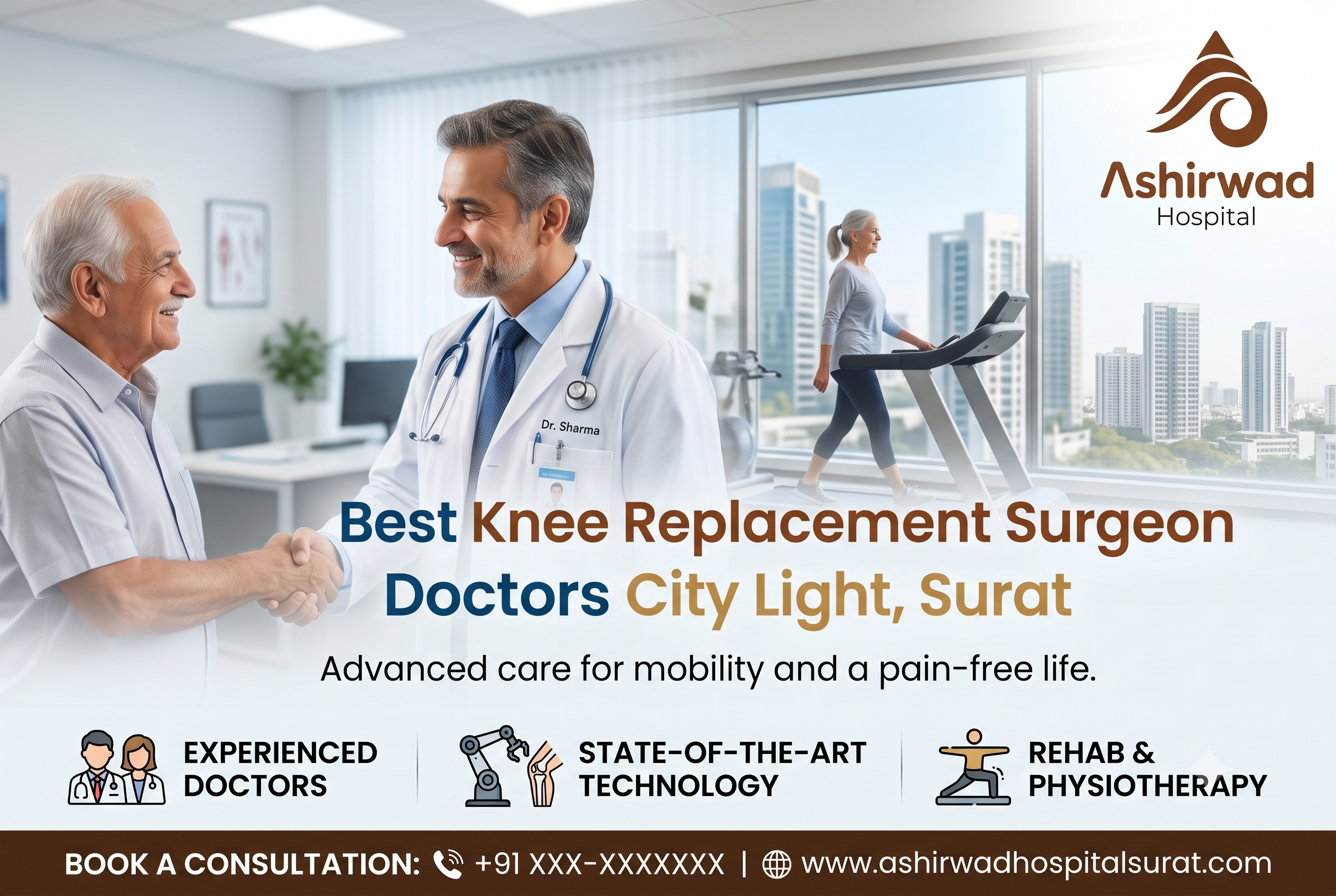
If knee pain has started interfering with your daily walks, stair climbs, or sleep, you are not alone. City Light is one of Surat’s busiest residential and commercial pockets, home to a large population of working professionals and senior citizens who often delay joint treatment simply because they do not know who to trust nearby. Finding the best knee replacement surgeon doctors in City Light, Surat is the single most important decision in that journey, and this guide walks you through everything you need: how to identify genuine knee pain, what surgical options exist, what the procedure costs in 2026, insurance and Ayushman card support, and why Ashirwad Hospital has become the preferred choice for patients across City Light, Athwa, Piplod, and the surrounding areas.
Why City Light Residents Need a Specialist Knee Replacement Surgeon Nearby
City Light sits close to VIP Road, Piplod, and Athwa, and its residents span a wide demographic, from young sports enthusiasts dealing with ligament injuries to elderly patients living with years of untreated osteoarthritis. Traveling across the city for every consultation, X-ray, and physiotherapy session is exhausting when your knee already hurts to walk on. A specialist orthopedic surgeon located close to City Light means shorter travel time for pre-surgery evaluations, faster access during emergencies, and easier follow-up visits during the recovery months that matter most.
Local access also matters for continuity of care. Knee replacement is not a single event; it is a relationship with your surgeon that spans consultation, imaging, the operation itself, in-hospital recovery, and months of physiotherapy afterward. A hospital located within a short drive of City Light lets your surgeon monitor your gait, swelling, and implant positioning in person rather than relying on phone updates. This is one of the biggest reasons patients from City Light increasingly search for a dedicated, nearby orthopedic team instead of settling for the first hospital that shows up in a generic search.
Another practical reason is emergency preparedness. Falls, sudden locking of the joint, or post-surgical complications need same-day attention. When your surgeon and hospital are minutes away rather than across the city, that proximity can materially change your outcome and your peace of mind.
Family involvement also becomes easier with a nearby hospital. Knee replacement recovery relies heavily on a support system, someone to help with daily exercises, transport to physiotherapy sessions, and general care during the first few weeks. When the hospital sits close to City Light rather than on the far side of Surat, family members can accompany patients to appointments without losing an entire day to travel, which in turn makes it easier to stick to the physiotherapy schedule that ultimately determines how well the new joint performs.
What to Expect During Your First Consultation
Many City Light residents put off their first orthopedic visit simply because they are unsure what it involves. A first consultation for knee pain typically starts with a detailed history: when the pain started, whether it followed an injury, what makes it better or worse, and how it affects your daily routine, from walking to your morning namaz or puja that involves kneeling. The surgeon will then examine your knee for swelling, range of motion, alignment, and stability.
Imaging usually follows the same day or shortly after. Standing X-rays of both knees, even if only one hurts, help the surgeon compare joint spacing and rule out compensatory damage on the other side. In some cases, particularly where ligament or cartilage damage is suspected rather than pure bone-on-bone arthritis, an MRI is recommended for a clearer picture before any surgical decision is made.
It is worth bringing any previous reports, a list of current medications, and details of conditions like diabetes, hypertension, or thyroid disorders, since these influence both anaesthesia planning and recovery pacing. Patients who prepare this information in advance usually get a clearer, faster treatment plan on their very first visit rather than needing a follow-up appointment just to gather basics.
How to Choose the Right Knee Replacement Surgeon in City Light
With several orthopedic clinics operating across Surat, City Light patients benefit from a short checklist before finalising a surgeon:
- Surgical volume: Ask how many knee replacements the surgeon performs each month. Regular volume generally correlates with more consistent outcomes.
- Qualifications and fellowships: Look for postgraduate orthopedic training plus dedicated fellowship experience in joint replacement or arthroplasty.
- Willingness to explain trade-offs: A good surgeon walks you through total versus partial replacement, robotic versus conventional technique, and implant options rather than pushing a single default choice.
- Transparent costing: Request a written estimate that separates surgeon fees, implant cost, hospital stay, and physiotherapy, so there are no surprises at discharge.
- Physiotherapy support: Confirm whether structured, in-house physiotherapy is part of the recovery plan, since this affects your outcome as much as the surgery itself.
- Proximity and follow-up access: For City Light residents, a hospital within easy reach reduces the stress of the multiple follow-up visits recovery requires.
Taking twenty minutes to compare two or three surgeons against this checklist is a small investment against a decision that affects your mobility for years to come.
Signs You May Need Knee Replacement Surgery
Not every ache in the knee calls for surgery, but ignoring persistent symptoms often makes the eventual procedure more complex. Watch for the following signs, which are also detailed in our guide on signs you need knee replacement in Surat:
- Constant or recurring knee pain that limits walking, climbing stairs, or getting up from a chair
- Visible swelling or warmth around the knee joint that does not settle with rest
- A grinding, clicking, or locking sensation when you bend or straighten the leg
- Stiffness that is worse first thing in the morning or after sitting for long periods
- Pain that disturbs sleep or persists even after taking standard pain relief
- Reduced range of motion that makes squatting, sitting cross-legged, or using Indian-style toilets difficult
- Visible bowing or deformity of the leg as cartilage wears away unevenly
- Dependence on a stick, walker, or family support for basic mobility
If two or more of these apply to you or an elderly family member, it is worth booking a consultation rather than waiting. Osteoarthritis, rheumatoid arthritis, post-traumatic arthritis, and avascular necrosis are the most common underlying causes seen in patients from City Light and nearby Adajan and Vesu. Early evaluation with X-rays and, where needed, an MRI helps your surgeon decide between conservative management, partial replacement, or total knee replacement, rather than jumping straight to the most invasive option.
Meet the Best Knee Replacement Surgeon Doctors Serving City Light, Surat
Patients from City Light consistently look for a surgeon who combines strong surgical volume with an approachable, communicative style. At Ashirwad Hospital, Dr. Ankit Chaudhari leads the joint replacement program with a practice built around detailed pre-surgical counseling, transparent cost discussions, and structured post-operative rehabilitation. His approach emphasizes explaining the “why” behind every recommendation, whether that is choosing a partial versus total replacement or deciding between a robotic-assisted and conventional technique.
What sets an experienced knee replacement surgeon apart is not just the operation itself but the entire pathway around it: an accurate diagnosis, correctly sized and positioned implants, careful management of pain in the first 48 hours, and a physiotherapy plan tailored to the patient’s age and lifestyle. Ashirwad Hospital’s orthopedic team follows this pathway for every patient, whether they arrive from City Light, Athwa, Nanpura, or further out in South Gujarat.
Qualifications worth checking when you shortlist a surgeon include a postgraduate degree in orthopedics (MS or DNB Ortho), fellowship training in joint replacement or arthroplasty, and a track record of regular surgical volume rather than occasional cases. It also helps to ask how complications and revisions are handled, since a surgeon’s approach to the rare difficult case says as much about their skill as their routine outcomes.
Types of Knee Replacement Surgery Offered
Knee replacement is not one single procedure; the right approach depends on how much of the joint is damaged, your age, activity level, and bone quality.
Total Knee Replacement (TKR) replaces the entire knee joint surface with a metal and polyethylene implant. This is the most common procedure for advanced osteoarthritis where damage spans the whole joint. You can read a detailed breakdown on our total knee replacement page.
Partial Knee Replacement is suitable when damage is limited to one compartment of the knee, usually the inner side. It preserves more of the patient’s natural bone and ligaments, often allowing a faster recovery. Details are covered on our partial knee replacement page.
Revision Total Knee Replacement becomes necessary when a previous implant loosens, wears out, or gets infected years after the original surgery. This is a more complex procedure requiring specialised planning, and our revision total knee replacement page explains what patients from City Light should expect if they are returning for a second surgery.
Bilateral Knee Replacement, where both knees are operated on either together or in a staged manner, is an option for patients with advanced arthritis in both joints. Our guide on bilateral knee replacement for patients travelling from Bharuch and nearby regions covers the decision-making process in depth, and the same principles apply to City Light residents weighing a single combined recovery period against two separate ones.
Your surgeon will typically confirm the right category only after reviewing your X-rays and clinical examination in person, so treat any online estimate as a starting point for discussion rather than a final answer.
Robotic-Assisted vs Conventional Knee Replacement: What Should You Choose?
One of the most common questions City Light patients ask during their first consultation is whether robotic-assisted surgery is worth the additional cost over conventional technique. Robotic assistance allows the surgeon to plan implant positioning using a 3D model of the patient’s own knee before a single cut is made, which can improve precision in alignment and soft tissue balancing. Conventional surgery, performed by an experienced surgeon, still delivers excellent long-term outcomes for the vast majority of patients and remains the more widely used, cost-effective option.
Our detailed comparison, robotic vs conventional knee replacement for South Gujarat patients, walks through the accuracy differences, cost gap, recovery timelines, and which patient profiles benefit most from robotic assistance, such as those with significant deformity or previous knee surgery. The short answer for most City Light patients with straightforward osteoarthritis: both techniques deliver reliable results, and the decision often comes down to budget, implant longevity expectations, and surgeon recommendation after examining your specific joint.
Knee Replacement Surgery Cost in City Light, Surat
Cost is usually the second question after safety, and it is a fair one. Total knee replacement costs in Surat in 2026 vary based on the type of implant used (standard versus high-flex or robotic-compatible), whether one or both knees are operated on, room category chosen during the hospital stay, and any pre-existing conditions that require additional management such as diabetes or cardiac clearance.
For a complete, itemised breakdown covering surgeon fees, implant cost, operation theatre charges, hospital stay, and physiotherapy, see our joint replacement cost guide for Surat, 2026. Rather than comparing a single headline number between hospitals, City Light patients are better served asking for a written estimate that separates implant cost, hospital charges, and post-operative physiotherapy, since bundled quotes can hide significant variation in what is actually included.
It is also worth asking your hospital whether the quoted cost includes pre-surgery investigations (blood work, ECG, X-rays), anaesthesia charges, and the standard follow-up visits in the first three months, since these add up if billed separately.
Insurance, Ayushman Card and Cashless Surgery Options
Surgery cost should never be the reason a patient in City Light delays treatment for a deteriorating knee. Most private insurance policies in India cover knee replacement under their surgical benefits, and government schemes extend coverage further for eligible families.
If you hold an Ayushman Bharat card, our guide on PMJAY joint replacement coverage in Gujarat explains eligibility, the empanelment process, and what portion of surgery costs the scheme typically covers. For patients holding private health insurance, our page on cashless surgery insurance support near Adajan at Ashirwad Hospital outlines how the hospital’s insurance desk handles pre-authorisation, documentation, and direct settlement with insurers so patients avoid large upfront out-of-pocket payments.
Before your surgery date is finalised, it is worth spending twenty minutes with the hospital’s insurance or billing team to confirm your policy’s room-rent limits, any sub-limits on implant cost, and whether pre-existing condition waiting periods apply to your policy. This single conversation prevents most billing surprises that families otherwise face after discharge.
Recovery Timeline After Knee Replacement Surgery
Recovery is where the real work of knee replacement happens, and patients who understand the timeline in advance tend to follow their rehabilitation plan more consistently. Our detailed week-by-week guide, knee replacement recovery timeline: what to expect, breaks down the entire journey, but broadly:
- Days 1 to 3: You will typically be encouraged to stand and take a few assisted steps within 24 hours of surgery, with pain managed through a structured medication plan.
- Weeks 1 to 3: Focus shifts to walking with a walker or stick, basic range-of-motion exercises, and wound care. Most patients are discharged within 3 to 5 days.
- Weeks 4 to 8: Structured physiotherapy builds strength and flexibility, and most patients transition from a walker to a stick, then to unassisted walking on flat surfaces.
- Months 3 to 6: Return to most daily activities, driving, and light household tasks; stair climbing and longer walks become comfortable for most patients.
- Month 6 onward: Continued strength building, with most patients reporting significant pain relief and improved quality of life compared to before surgery.
Structured physiotherapy is not optional; it is the single biggest factor separating a good outcome from an excellent one. Our page on physiotherapy after joint replacement in Surat covers the exercises, frequency, and home-care routine patients from City Light should follow during each recovery phase.
Why Choose Ashirwad Hospital for Knee Replacement in City Light, Surat
Ashirwad Hospital has built its orthopedic reputation on a few consistent principles: honest pre-surgical counseling, a dedicated joint replacement team rather than a generalist approach, transparent cost estimates before admission, and a structured rehabilitation program that continues well after discharge. Patients from City Light appreciate the hospital’s location, which keeps travel time low for both the initial consultation and the frequent follow-up visits recovery requires.
Beyond surgical skill, what matters to most families evaluating a hospital is how questions are answered, how clearly costs are explained, and how supported patients feel during the anxious weeks before surgery and the demanding weeks after it. You can learn more about the hospital’s background, specialities, and the wider orthopedic team on the About Us page.
The hospital’s broader orthopedic practice, covering everything from hip replacement and spine surgery to sports injury rehabilitation, means that if your knee condition is connected to a wider musculoskeletal issue, the same coordinated team can manage it without referring you elsewhere.
Frequently Asked Questions
1. Who is the best knee replacement surgeon for patients in City Light, Surat? Dr. Ankit Chaudhari at Ashirwad Hospital leads the joint replacement program serving City Light and surrounding neighbourhoods, with a focus on personalised surgical planning and structured post-operative rehabilitation.
2. How do I know if I need a total or partial knee replacement? This depends on how much of the knee joint is damaged. Your surgeon will assess this through a clinical examination and X-rays; partial replacement is only suitable when damage is limited to one compartment of the knee.
3. Is robotic knee replacement better than conventional surgery? Robotic assistance can improve implant positioning precision, but conventional surgery performed by an experienced surgeon remains a reliable, cost-effective option for most patients. The right choice depends on your specific knee condition and budget.
4. How much does knee replacement surgery cost in Surat in 2026? Costs vary based on implant type, whether one or both knees are treated, and room category. See our detailed cost breakdown guide for itemised figures.
5. Does Ayushman Bharat cover knee replacement surgery in Surat? Eligible cardholders can access coverage for joint replacement under PMJAY at empanelled hospitals. Read our PMJAY coverage guide for eligibility details.
6. How long does it take to walk normally after knee replacement? Most patients walk with support within the first week and transition to unassisted walking on flat surfaces by around 6 to 8 weeks, with continued improvement through month six.
7. Can both knees be replaced at the same time? Yes, bilateral knee replacement is possible for suitable candidates, either as a combined procedure or in two staged surgeries. Our bilateral knee replacement guide explains how surgeons decide which approach fits a patient’s health profile.
8. What is the ideal age for knee replacement surgery? There is no fixed age cutoff. The decision depends on the severity of joint damage, pain levels, and how much daily function is affected, rather than age alone. Some patients in their forties with advanced post-traumatic arthritis need surgery earlier, while others with mild wear can delay it well into their seventies with conservative management.
9. How painful is the recovery period after knee replacement? Modern pain management protocols, including nerve blocks and multimodal medication, keep post-surgical pain considerably lower than most patients expect. Discomfort is usually well controlled within the first few days and steadily decreases through physiotherapy-driven recovery.
10. Will I need to change my lifestyle permanently after knee replacement? Most patients return to normal daily activities, walking, light exercise, and travel. High-impact activities like running or heavy squatting are generally discouraged to protect implant longevity, but low-impact exercise, walking, swimming, and cycling are usually encouraged as part of long-term joint health.
Book Your Consultation Today
If knee pain has been holding you back from daily life in City Light, the next step is a proper clinical evaluation rather than more waiting. Ashirwad Hospital’s orthopedic team can assess your X-rays, discuss whether total, partial, or robotic-assisted knee replacement fits your condition, and walk you through cost and insurance options before you commit to anything. Visit our Contact Us page to book a consultation and take the first step toward walking without pain again.