
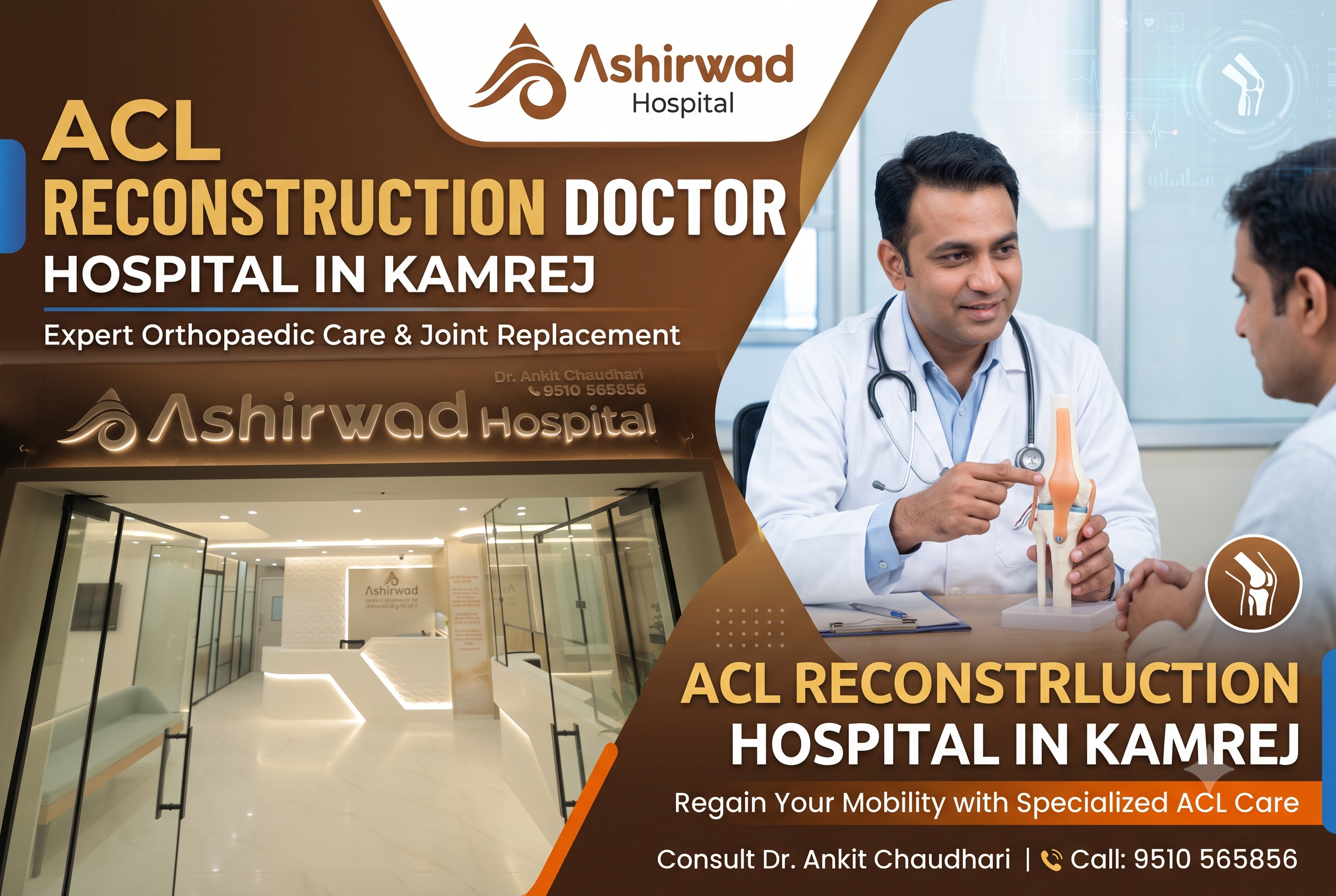
If you twisted your knee on the cricket ground, slipped on a wet floor, or took a hard fall from a bike near Kamrej and felt your knee give way, you may be dealing with a torn anterior cruciate ligament. Many people ignore the first few weeks of swelling and wobbling, hoping it will settle on its own. Often it does not. A torn ACL rarely heals without treatment, and a knee that keeps buckling can slowly damage the meniscus and cartilage inside the joint.
Choosing the right ACL reconstruction doctor in Kamrej is the most important decision you will make after the injury. This guide explains what the ACL does, how to recognise a tear, how a specialist hospital confirms the diagnosis, what happens during arthroscopic ACL surgery, how recovery works, and what to look for in an ACL surgeon near Kamrej. It is written by the team at Ashirwad Hospital Surat, where Dr. Ankit Chaudhari treats ligament injuries every week.
What Is the ACL and Why Does It Matter?
The anterior cruciate ligament, or ACL, is a strong band of tissue deep inside the knee. It connects the thigh bone (femur) to the shin bone (tibia) and works like a stabiliser. Its main job is to stop the shin bone from sliding forward and to control rotation when you pivot, jump, or change direction.
When the ACL is intact, you rarely think about it. When it tears, the knee can feel loose, unreliable, and painful on uneven ground. Because the ligament has a poor blood supply, a complete tear does not knit back together the way a skin cut does. That is why an experienced ACL tear treatment doctor will usually discuss reconstruction for active patients with a complete tear.
Common Causes of ACL Tears in Kamrej and Surat
Most ACL injuries happen without direct contact. The foot stays planted while the body twists, which overloads the ligament. In and around Kamrej, we commonly see tears from:
- Football, cricket, kabaddi, badminton, and volleyball
- Sudden stops or sidesteps while running
- Awkward landings after a jump
- Two wheeler accidents and road traffic injuries on the highway
- Falls at home, on stairs, or at the workplace
- Industrial and factory floor injuries
Women athletes and young adults between 15 and 45 years of age are affected more often, but we also treat office workers, farmers, and active seniors who want to return to normal walking and daily work without the knee giving way.
Symptoms That Mean You Should See an ACL Doctor
Not every knee injury is an ACL tear, but the following signs deserve a proper orthopaedic examination:
- A popping sound or sensation at the time of injury
- Rapid swelling within a few hours
- Pain on the inside or outside of the knee
- A feeling that the knee is giving way when you walk or turn
- Difficulty fully straightening or bending the knee
- Trouble climbing stairs or getting up from a chair
- Loss of confidence in the leg during sport
If you notice these symptoms, avoid forcing the knee, rest it, apply ice, and consult an ACL surgery doctor within a week or two. Early assessment protects the cartilage and meniscus and gives you more treatment options. If the injury was caused by a major accident, with severe swelling, deformity, or inability to bear weight, visit our emergency surgery treatment in Surat department straight away.
How Is an ACL Tear Diagnosed at a Hospital?
A confident diagnosis needs both a skilled hands-on examination and good imaging. At Ashirwad Hospital, the process usually follows these steps.
1. Detailed history. Dr. Ankit Chaudhari asks how the injury happened, whether you heard a pop, how quickly the knee swelled, and what you do for work and sport.
2. Clinical tests. Hands-on tests such as the Lachman test, anterior drawer test, and pivot shift test check how much the shin bone moves forward and rotates. An experienced surgeon can often suspect a tear from these tests alone.
3. X-ray. An X-ray does not show the ligament, but it rules out fractures and checks joint alignment.
4. MRI scan. MRI is the gold standard for confirming an ACL tear. It also shows damage to the meniscus, cartilage, and other ligaments, which affects the surgical plan.
Our diagnostics and imaging team handles X-rays, ultrasound, CT, and MRI, so you do not have to run between different centres. You can read more about the full range of tests on our page for ECG, X-ray, ultrasound, CT scan and MRI tests in Surat.
Do You Always Need ACL Surgery?
No. The right treatment depends on the grade of the tear, your age, your activity level, and whether other structures are damaged.
Non-surgical treatment may suit patients with a partial tear, older patients with low activity demands, or those whose knee feels stable during daily life. It includes a structured physiotherapy programme, strengthening of the thigh and hip muscles, balance training, and sometimes a hinged knee brace. You can learn about this route on our non-surgical treatments page.
Surgical treatment is usually advised when:
- The ACL is completely torn and the knee keeps giving way
- You play sport that involves pivoting or jumping
- Your job needs stable knees, such as construction, delivery, or factory work
- The meniscus or other ligaments are also torn
- Non-surgical treatment has failed after a reasonable trial
A good ACL surgeon will not push you toward an operation. The goal is a stable, strong knee that fits your life, and sometimes that means rehabilitation first.
What Is ACL Reconstruction Surgery?
ACL reconstruction replaces the torn ligament with a new graft, a strip of tendon that acts as a scaffold for a new ligament. Today the operation is done with arthroscopic (keyhole) surgery, which means small cuts and a tiny camera instead of a large open incision. This approach usually leads to less pain, less scarring, and faster early recovery than open surgery.
Our ACL tear surgery in Surat service follows a clear, step by step process, and our wider arthroscopy and sports injury programme covers other knee, shoulder, and ankle problems.
Step by Step: What Happens During the Operation
- Anaesthesia. The anaesthetist gives spinal or general anaesthesia, chosen after a pre-operative check.
- Arthroscopic inspection. Small portals are made around the knee and a camera examines the joint. Any meniscus or cartilage injury is assessed and treated in the same sitting where possible.
- Graft harvest. The surgeon prepares the graft tissue, most often from your own hamstring tendons.
- Tunnel preparation. Small tunnels are drilled in the thigh bone and shin bone at the natural attachment points of the ACL.
- Graft fixation. The graft is passed through the tunnels and secured with fixation devices.
- Closure and bandaging. The portals are closed, a dressing is applied, and you move to the recovery room.
The operation commonly takes about one to two hours, depending on the damage found inside the knee.
Graft Options Explained
| Graft type | Source | Why surgeons choose it |
|---|---|---|
| Hamstring tendon | Your own thigh tendons | Small incisions, less front knee pain, widely used |
| Patellar tendon | Your own kneecap tendon | Strong bone to bone healing, often used in high demand athletes |
| Quadriceps tendon | Your own thigh tendon | Thick graft, useful in revision or special cases |
| Allograft | Donor tissue | Avoids harvest pain, sometimes used in older patients or multiple ligament injuries |
There is no single best graft for everybody. Dr. Ankit Chaudhari explains the pros and cons of each option during your consultation and recommends the one that matches your body and goals.
When ACL Injuries Come With Other Damage
An ACL tear rarely travels alone. Many patients also have a torn meniscus, bruised cartilage, or a stretched collateral ligament. Treating these together gives the best long term outcome. If the meniscus is torn, our team can discuss meniscus repair surgery, and for cartilage injury we offer cartilage surgery. Posterior ligament injuries are managed through our PCL reconstruction and repair pathway. For a broader view of tendon and ligament problems, see our ligament and tendon repair page.
Why Patients From Kamrej Choose Ashirwad Hospital
Kamrej is a fast growing area with many working families, factory workers, and young sports players. When a knee injury happens, people want a hospital that is reachable, transparent, and focused on bone and joint care. Here is what patients tell us matters most, and how Ashirwad Hospital responds.
A dedicated orthopaedic focus. Ashirwad Hospital is built around bone, joint, spine, and sports injury care, so the team, equipment, and rehab routines are all oriented toward the knee, not scattered across unrelated specialities.
A surgeon you meet before and after surgery. Dr. Ankit Chaudhari personally evaluates your knee, reviews your MRI, and explains the plan in simple language. You can read about the team on our team page and learn more about the hospital on our about us page.
Modern arthroscopic technique. Keyhole surgery lets us treat the ACL and any associated meniscus or cartilage damage through small portals.
Clear costs and fees. We believe patients deserve to know what to expect before they commit. Our page on orthopaedic doctor fees at Ashirwad Hospital explains consultation charges, and our team will give a written estimate for surgery after your MRI.
Support with insurance and government schemes. Our staff help with cashless claims and Ayushman card paperwork so families can focus on recovery.
Integrated physiotherapy. Rehabilitation begins in hospital and continues under guided protocols, supported by our orthopaedic rehabilitation service.
If you want a general overview of our knee care before booking, visit our guide to the best orthopaedic hospital and doctor in Kamrej.
How to Choose the Best ACL Reconstruction Doctor Near Kamrej
Searching for an ACL surgeon near me brings up many names. Use this checklist to compare options calmly.
- Experience with ACL surgery. Ask how many ACL reconstructions the surgeon performs each year and whether arthroscopy is their routine method.
- Time for examination. A good doctor examines the knee carefully and reviews the MRI with you, rather than prescribing surgery from a quick glance.
- Honest alternatives. The surgeon should explain non-surgical options and not promise unrealistic results.
- Graft discussion. You should be told which graft is planned and why.
- Treatment of associated injuries. Meniscus and cartilage problems should be addressed in the same plan.
- Rehabilitation support. Surgery is only half of ACL treatment. A structured physiotherapy plan decides how well the knee performs a year later.
- Transparent pricing and insurance help. Ask for a written estimate and clarity on what is covered.
- Hospital facilities. Look for a clean operation theatre, in-house diagnostics, and round the clock nursing support.
- Patient communication. You should feel comfortable asking questions. If you want a second view on a surgical recommendation, our page on second opinion for knee and hip surgery in Surat explains how that works.
ACL Reconstruction Recovery Timeline
Recovery is a journey of months, not days. Every patient heals at a different speed, but the typical phases look like this.
Day 1 to 2 (hospital stay). Pain control, ice therapy, and gentle ankle and knee movement begin. Most patients walk with crutches before discharge. Many arthroscopic ACL patients go home within one to two days.
Week 1 to 2. Focus on swelling control, wound care, straightening the knee fully, and activating the thigh muscle. Walking with crutches continues.
Week 2 to 6. Range of motion improves, and weight bearing increases as your surgeon permits. Stationary cycling and light strengthening begin.
Month 2 to 4. Strength, balance, and walking pattern improve. Most people return to desk work and normal daily activities, though heavy labour may need longer.
Month 4 to 6. Running in a straight line, controlled agility work, and sport specific drills are introduced if strength and stability tests are satisfactory.
Month 6 to 9 or longer. Return to cutting and pivoting sports is considered once strength, hop tests, and confidence meet your surgeon’s criteria. Many surgeons prefer about nine months or more before full competition because early return raises the risk of re-injury.
Rushing back because the knee “feels fine” is the most common reason for graft failure. Follow the plan, attend every physiotherapy session, and let objective tests guide your return to sport. Our best rehabilitation centre for sports injury in Surat page describes how we structure that process.
Possible Risks and Complications
ACL reconstruction is a well established operation, and most patients do well. Like any surgery, it carries risks that your doctor should discuss openly:
- Infection at the wound or inside the joint
- Stiffness or difficulty regaining full movement
- Pain at the graft harvest site
- Blood clots in the leg veins
- Graft stretching, loosening, or re-tear
- Numbness around the scar
- Anaesthesia related reactions
Careful technique, sterile theatre protocols, early movement, and disciplined rehabilitation reduce these risks. Report fever, increasing redness, severe calf pain, or sudden swelling to your doctor immediately.
ACL Surgery Cost in Kamrej and Surat
Patients often ask for a single figure, but ACL surgery cost varies from person to person. The main factors are:
- The type of graft and fixation devices used
- Whether meniscus or cartilage repair is needed during the same surgery
- The type of room and length of stay
- Anaesthesia and investigation charges
- Physiotherapy sessions after surgery
- Insurance or scheme coverage
The best way to know your exact cost is a consultation with an MRI review, followed by a written estimate. For a broader view of how we price orthopaedic care, you can read our joint replacement cost guide for Surat, which explains the same transparent approach we follow across procedures.
Ayushman Card, PMJAY, and Cashless Insurance
Many families in Kamrej, Olpad, and nearby villages hold an Ayushman card or private health insurance. Coverage rules, eligible packages, and approvals can change, so always confirm the current status with our hospital desk before admission. We have detailed guides to help you:
- Ayushman card ACL surgery in Surat at Ashirwad Hospital
- Ayushman card ACL surgery in Olpad
- PMJAY coverage for joint procedures in Gujarat
- Cashless surgery and insurance support
Our front desk can check your eligibility and explain what documents to bring.
Areas We Serve Around Kamrej
Patients visit Ashirwad Hospital from Kamrej, Olpad, Palsana, Bardoli, Hazira, Pal, Adajan, Vesu, and other parts of south Gujarat. If you live elsewhere in Surat, you may find these local guides useful:
- ACL reconstruction doctor in Adajan, Surat
- ACL reconstruction doctor in Vesu, Surat
- ACL reconstruction doctor in Pal, Surat
- ACL reconstruction doctor in Hazira
If you also have arthritis or advanced knee wear, our guide to the best knee replacement surgeon in Kamrej explains when joint replacement becomes the better option.
Frequently Asked Questions About ACL Reconstruction in Kamrej
Who is the best ACL reconstruction doctor in Kamrej?
The best doctor for you is a fellowship trained or experienced orthopaedic surgeon who regularly performs arthroscopic ACL surgery, explains alternatives honestly, and supports your rehabilitation. Dr. Ankit Chaudhari at Ashirwad Hospital Surat treats ACL tears and other sports injuries, and patients from Kamrej can book a consultation to discuss their MRI and options.
Can an ACL tear heal without surgery?
A complete ACL tear does not usually heal on its own. Some patients with partial tears or low activity levels manage well with physiotherapy and bracing. Active patients and those whose knee keeps giving way are generally advised to consider reconstruction.
How long does ACL reconstruction surgery take?
The operation commonly takes about one to two hours, though the exact time depends on the graft chosen and any additional meniscus or cartilage work.
How many days do I stay in the hospital?
Many patients go home within one to two days after arthroscopic ACL reconstruction, once pain is controlled and they can walk safely with crutches.
When can I return to work?
Desk work can often resume within two to four weeks, depending on comfort and travel. Jobs that involve heavy lifting, long standing, or climbing may need three months or more.
When can I play sport again?
Running usually begins around four to six months, and return to pivoting sports is commonly considered after nine months or longer, once strength and stability tests are satisfactory. Returning too early raises the risk of re-injury.
Is ACL surgery covered under the Ayushman card?
Coverage depends on current scheme rules, package eligibility, and hospital empanelment. Please check with our hospital desk before admission. Our guide to Ayushman card ACL surgery in Surat explains the usual steps.
Book Your ACL Consultation at Ashirwad Hospital Surat
A torn ACL does not have to end your active life. With an accurate diagnosis, a clear surgical plan, and disciplined rehabilitation, most patients get back to the things they love. If you are searching for an ACL reconstruction doctor and hospital in Kamrej, Dr. Ankit Chaudhari and the team at Ashirwad Hospital Surat are ready to assess your knee, review your MRI, and guide you toward the right treatment.
Visit our contact us page to book an appointment, or explore our full range of orthopaedic services and sports injury care.
Medical disclaimer: This article is for general education and does not replace a personal medical examination. Treatment decisions should be made after consultation with a qualified orthopaedic surgeon.