

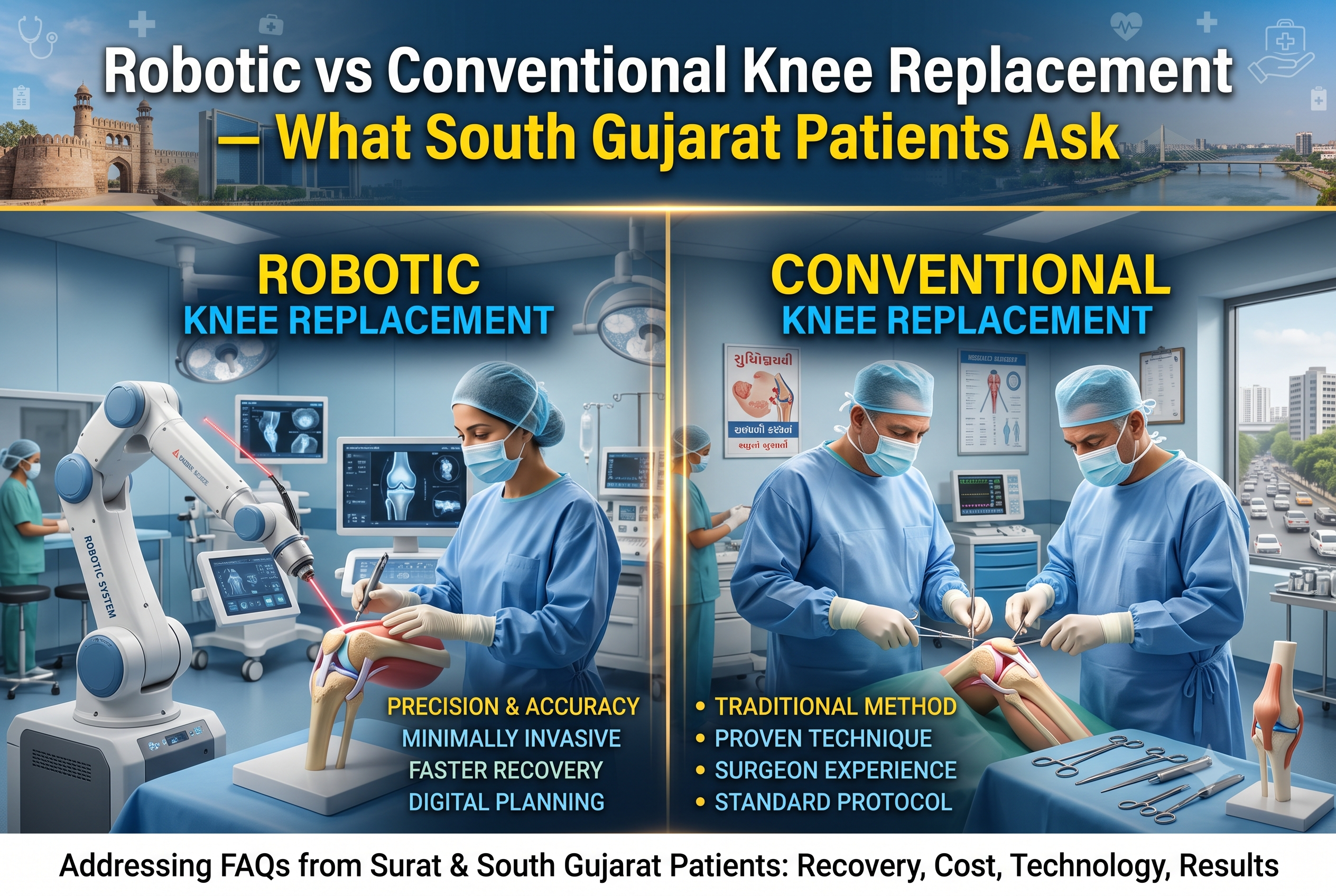
If you’ve been sitting with knee pain long enough to start Googling “robotic knee replacement Surat” at eleven at night, you already know the basic pitch. Robotic sounds newer, more precise, more expensive. Conventional sounds proven, familiar, and like what your neighbour’s father had done two years ago in Adajan. What nobody tells you upfront is that both are real surgeries performed by the same surgeon’s hands, and the robot is a planning and precision tool, not a replacement for the orthopedic surgeon doing the operating.
At Ashirwad Hospital in Surat, this is one of the first questions almost every patient from Vesu, Athwa, Piplod, Rander or the wider South Gujarat belt brings into the first consultation. So instead of another generic explainer, this is a walkthrough of what patients here actually ask, in the order they usually ask it.
What Actually Happens During Conventional Knee Replacement
Conventional total knee replacement, sometimes written as TKA or TKR, has been the standard operation for damaged or arthritic knees for several decades. The surgeon opens the joint, looks at the bone directly, and uses instruments called jigs — metal cutting guides — along with pre-operative X-rays to decide the angle and depth of bone resection. Soft tissue balance, meaning how tight or loose the ligaments feel around the new implant, is judged largely by the surgeon’s hands and experience during the operation itself.
This is not a crude method. Surgeons who have done thousands of these operations develop a genuinely reliable feel for alignment and tension, and outcomes for experienced hands are excellent. The limitation is that the plan is set mostly in the surgeon’s head and adjusted by touch, rather than measured and confirmed by a machine at every step. In more complex knees, particularly ones with significant deformity or previous fracture, that judgment call becomes harder to get exactly right every single time.
How Robotic-Assisted Knee Replacement Is Different
Robotic-assisted knee replacement does not mean a robot performs surgery on its own. The surgeon is still the one making every cut and placing the implant. What changes is the planning and the feedback loop. Before the operation, a CT scan or, in some systems, an intraoperative scan is used to build a 3D model of your specific knee. The surgeon uses that model to plan implant size, position and alignment down to a millimetre before a single incision is made.
During the surgery, a robotic arm guides the bone-cutting instruments within the boundaries set in that plan. If the surgeon’s hand drifts outside the planned cutting zone, the system resists or stops. Several platforms also let the surgeon test ligament tension in real time and adjust the plan on screen before finalising bone cuts, rather than relying purely on feel. In effect, robotic assistance turns some of what used to be intraoperative judgment into something that is measured and checked against a plan.
Is Robotic Knee Replacement Actually More Accurate?
This is where South Gujarat patients tend to want a straight answer rather than marketing language, so here it is, based on the current clinical literature rather than a sales pitch.
A 2023 systematic review and meta-analysis of randomized controlled trials, published through a peer-reviewed orthopedic journal and covering data through mid-2022, compared robotic and conventional total knee arthroplasty on radiological alignment as well as functional outcomes. The finding was consistent: robotic surgery produced better post-operative anatomical and mechanical alignment than conventional surgery. On the other hand, clinical and functional scores — how the knee actually performed for patients, complication rates included — were broadly similar between the two groups. In simpler terms, the robot measurably improves how straight and well-positioned the implant sits, but at this stage of the evidence, that improved alignment hasn’t yet translated into a clearly bigger difference in how patients feel or function afterward, at least not in the timeframes these trials tracked.
A separate meta-analysis focused specifically on partial (unicompartmental) knee replacement found something similar: better hip-knee-ankle alignment and slightly better Oxford Knee Scores with robotic assistance, but no significant difference in pain, range of motion or overall joint awareness between the two approaches.
What this means practically: alignment is a real, measurable advantage for robotic surgery, and precise alignment matters most in knees with unusual anatomy, prior fractures, or significant deformity, where a conventional jig-based approach has less room to adapt. For a straightforward knee in a patient with reasonably normal anatomy, a highly experienced conventional surgeon can often achieve very similar alignment by hand. The gap tends to widen in harder cases, not easier ones.
Does Robotic Surgery Mean Less Pain and a Faster Recovery?
Patients ask this constantly, and the honest answer is “probably a bit, but not dramatically, and not for everyone.” Robotic-assisted surgery is generally associated with smaller, more precise bone cuts and less disruption to surrounding soft tissue, since less is being removed on estimation alone. Some hospital data, including observations shared by surgeons at larger centres such as Cleveland Clinic in the US, points to shorter hospital stays and a higher rate of patients going straight home rather than to a rehab facility after robotic surgery. Interestingly, the same data showed conventional surgery had shorter operating time on the table, and complication rates were statistically the same between both groups.
So the pattern that shows up again and again in the data is this: robotic surgery tends to win on precision and, in some studies, on hospital stay length. Conventional surgery tends to win on speed of the operation itself. Neither has a clear, universal edge on pain control or long-term complication rates. If a clinic or website promises robotic surgery is painless or guarantees a faster return to work, treat that as marketing rather than evidence — recovery still depends heavily on your age, weight, pre-surgery muscle strength, and how seriously you follow physiotherapy afterward, regardless of which method was used.
Cost Difference in Surat, and What Ayushman Bharat Actually Covers
This is usually the second question after “which is better,” and it deserves a direct answer rather than a vague range. Robotic-assisted knee replacement costs more than conventional surgery at essentially every hospital that offers both, because the robotic system itself, the CT-based planning, and the disposable instrumentation used with the robot add real cost on top of the standard implant and surgical fees. In Surat and the wider South Gujarat market, that gap typically runs into tens of thousands of rupees per knee, though the exact figure depends on the implant brand, the robotic platform used, and whether it’s a single or bilateral (both knee) procedure.
If you’re planning to use an Ayushman Bharat card, it’s worth knowing upfront that empanelled packages under the scheme are built around conventional total knee replacement, and coverage for the additional cost of robotic-assisted surgery is limited or not available in most cases — this is not specific to Ashirwad Hospital, it’s how the scheme’s package rates are structured nationally. Patients who want to use their Ayushman card for total knee replacement and also want the robotic approach should ask directly during their consultation what portion, if any, would be out of pocket. Ashirwad Hospital’s team walks Ayushman-eligible patients through exactly what’s covered and what isn’t before any decision is made, rather than after.
Who Actually Benefits Most From Robotic Assistance
Not every knee needs a robot, and a good surgeon will tell you that honestly instead of upselling it. Based on the clinical patterns described above, robotic assistance tends to offer the clearest benefit for:
Patients with significant knee deformity, such as severe bow-leg (varus) or knock-knee (valgus) alignment, where getting the cut angles right by hand is genuinely harder.
Patients who’ve had a previous fracture, prior surgery, or hardware (plates, screws) around the knee or thigh that distorts normal anatomical landmarks.
Younger, more active patients who plan to put more years and more load on the implant, where alignment precision has a longer runway to matter.
Patients undergoing partial knee replacement rather than total, where the margin for error is smaller because less bone and cartilage is being replaced.
For a relatively straightforward knee in an older, lower-activity patient, in the hands of an experienced surgeon, conventional total knee replacement remains a well-proven, reliable option, and the outcome difference is often small.
Recovery Timeline, Side by Side
Patients often want a week-by-week picture rather than a general reassurance that “recovery is similar.” Here’s roughly how the two compare, based on typical patterns seen across both approaches rather than any single guaranteed outcome, since individual recovery still depends on age, weight, and pre-surgery fitness.
In the first 24 to 48 hours, both groups are usually assisted out of bed and taking a few supported steps, with pain managed through a combination of nerve blocks, oral medication and ice. Hospital stay for conventional TKR is commonly around 3 to 5 days in Surat hospitals; robotic-assisted cases sometimes discharge a day earlier when the knee has less swelling from smaller, more precisely planned bone cuts, though this isn’t universal.
Weeks 1 through 3 are the hardest stretch for almost everyone regardless of surgical method — this is when swelling peaks, physiotherapy intensifies, and bending the knee past 90 degrees starts to matter for daily tasks like using stairs or a squat toilet. Neither robotic nor conventional patients get to skip this phase; it’s driven by soft tissue healing, not by how the bone was cut.
By weeks 6 to 8, most patients in both groups are walking without a stick indoors and starting to resume light daily activities. Return to driving typically falls somewhere in this window too, depending on which knee was operated on and whether it’s an automatic or manual vehicle. By 3 months, the functional gap between robotic and conventional patients, where it exists at all, tends to be small — this lines up with what the meta-analyses found on clinical and functional scores.
The one place robotic surgery has shown a more consistent edge in hospital-level data is discharge destination: more robotic-assisted patients go straight home rather than to a step-down rehab facility, compared to conventional patients. If avoiding an extended rehab stay matters to your family’s logistics, that’s worth raising directly during consultation.
Choosing the Right Implant and Surgeon, Not Just the Right Machine
It’s easy to get pulled into a robot-versus-no-robot debate and lose sight of the two things that matter more for long-term outcome: implant selection and surgeon experience. Modern knee implants, whether placed with robotic guidance or conventional instruments, are rated for well over 90% survivorship at 15 to 20 years in registry data, and the difference between reputable implant brands matters less than getting the sizing and alignment right for your specific knee. A surgeon who has done a few hundred conventional replacements and knows exactly how a particular implant behaves in Indian patients with typical squatting and floor-sitting habits brings something a robot doesn’t measure: judgment about how the knee will actually be used after surgery, not just how straight it sits on X-ray. This is why the recommendation from Ashirwad Hospital’s team is rarely “robotic is automatically better” — it’s a case-by-case call based on your scan, your activity level, and, honestly, your budget.
Questions Patients From Vesu, Adajan, Piplod, Rander and Athwa Actually Ask
“Will I be awake or feel the robot during surgery?” No. Both robotic and conventional knee replacement are done under spinal or general anaesthesia. You won’t feel or hear the robotic arm working. The extra step patients notice is a pre-operative CT scan, which conventional surgery doesn’t require.
“Does robotic surgery mean smaller scars?” Not necessarily. Incision size depends more on the surgical approach the surgeon uses than on whether a robot assists. Some robotic systems do allow slightly smaller cuts because less soft tissue needs to be moved aside to estimate alignment visually, but this varies by case and shouldn’t be assumed automatically.
“How much extra does robotic knee replacement cost compared to conventional, in Surat specifically?” It depends on implant choice and whether it’s one knee or both, but expect a meaningfully higher package cost than standard conventional TKR. Ask for a written cost breakdown during consultation rather than a verbal estimate — Ashirwad Hospital provides this upfront for both approaches so you can compare directly.
“I’m 68 with diabetes — am I too high-risk for robotic surgery?” Age and diabetes alone don’t rule out either approach. What matters more is how well-controlled your sugar levels are, your overall cardiac fitness, and bone quality on imaging. This gets assessed the same way regardless of which surgical method is chosen, through pre-anaesthesia and orthopedic evaluation.
“Can I get robotic surgery on one knee and conventional on the other if I need both replaced?” Yes, this is done. Some patients choose robotic for the more deformed or complicated knee and conventional for the more straightforward one, mainly to manage cost. Discuss this directly with your surgeon rather than assuming it isn’t an option.
“How long before I can walk without support after each type?” Most patients from both groups are standing and taking supported steps within 24 to 48 hours, with a walker or stick needed for roughly 3 to 6 weeks. Robotic surgery does not reliably shorten this window on its own — physiotherapy compliance is the bigger factor by far.
“Is robotic knee replacement even available in Surat, or do I need to travel to Ahmedabad or Mumbai?” It’s available locally, including at Ashirwad Hospital, so travelling out of South Gujarat for the robotic option specifically isn’t necessary for most patients.
“My father had conventional TKR two years ago and is doing fine — does that mean robotic wasn’t needed back then either?” Possibly. If his knee had relatively normal alignment going in and he had an experienced surgeon, a good conventional outcome doesn’t tell you much about what’s right for a different knee with different anatomy. Each case gets assessed on its own imaging, not by comparing to a relative’s outcome.
“If I need both knees done, should they be operated together or one at a time?” This depends on your fitness, cardiac clearance and how well you tolerate the first surgery’s rehab, not on whether you choose robotic or conventional. Many surgeons in Surat prefer staging bilateral cases a few weeks apart for older or higher-risk patients, purely as a safety decision unrelated to the surgical method.
“Does robotic surgery lower the chance I’ll need a revision surgery later?” The theory is plausible, since better alignment is linked to lower long-term wear in registry studies, but the current randomized trial data hasn’t yet shown a statistically significant difference in revision rates between robotic and conventional groups over the follow-up periods studied so far. It’s a reasonable long-term hope, not yet a proven guarantee.
How to Actually Decide
Strip away the marketing on both sides and the decision comes down to three things: how deformed or complex your specific knee is on imaging, how much the cost difference matters to your budget or your Ayushman eligibility, and how experienced your surgeon is with whichever method you choose. A skilled surgeon using conventional instruments on a straightforward knee can match a robotic outcome. A skilled surgeon using robotic assistance on a complex, deformed knee has a real, evidence-backed edge in getting the alignment right. The honest starting point isn’t “which technology is better” in the abstract, it’s getting your own knee imaged and assessed so the recommendation is based on your joint, not a general comparison chart.
If you’re weighing this decision and want it looked at properly rather than guessed at from an X-ray alone, Ashirwad Hospital’s orthopedic team sees this exact question from patients across Vesu, Adajan, Athwa, Piplod, Rander, Olpad and Hazira every week, and can tell you during consultation which approach actually fits your knee rather than which one is being pushed hardest.
Robotic vs Conventional Knee Replacement — Quick Comparison
Patients often want the whole comparison in one place before they read the reasoning behind it, so here it is as a straight side-by-side, with the detail on each point covered further down.
| Factor | Conventional Knee Replacement | Robotic-Assisted Knee Replacement |
|---|---|---|
| Pre-op planning | X-ray based, templated by the surgeon | CT-based 3D model of your specific knee |
| Bone cutting | Manual jigs, guided by the surgeon’s hands | Robotic arm guided within a pre-set plan, surgeon still operates it |
| Alignment accuracy | Reliable in experienced hands, more variable in complex knees | Measurably better alignment in trial data, especially in deformed knees |
| Functional outcome at 3–12 months | Comparable in most studies | Comparable in most studies |
| Complication rates | Similar to robotic | Similar to conventional |
| Operating time | Generally shorter | Generally longer, due to registration and planning steps |
| Hospital stay | Typically 3–5 days in Surat | Sometimes 1 day shorter, not guaranteed |
| Cost in Surat | Lower, standard TKR package | Higher, additional charge for robotic platform and CT planning |
| Ayushman Bharat coverage | Covered under standard TKR package | Package rates built around conventional TKR; robotic add-on usually out of pocket |
| Best suited for | Straightforward knees, older or lower-activity patients, budget-conscious patients | Significant deformity, prior fracture or hardware, partial knee replacement, younger and more active patients |
This table is a summary, not a substitute for imaging. Two patients with the same age and the same complaint can have very different knee anatomy on a scan, and that scan is what actually decides which column applies to you.
What the Surgery Day Itself Looks Like, Step by Step
A lot of the anxiety patients bring into consultation isn’t really about robotic versus conventional — it’s about not knowing what the day of surgery involves at all. Walking through it tends to help, regardless of which method is chosen.
You’ll usually be admitted the evening before or early morning of surgery, with pre-anaesthesia checks, fasting instructions and consent finalised at that point. For robotic cases, a CT scan will already have been done in the days before admission, not on the day itself, so surgery day doesn’t take noticeably longer to start.
In the operating room, both approaches begin the same way: spinal or general anaesthesia, positioning, and the surgical incision. From there, a conventional case proceeds with jig-based cutting guides fixed directly to the bone. A robotic case adds a registration step, where the robotic system matches the CT-based plan to your knee’s actual position on the table, typically adding 10 to 20 minutes before cutting begins. After that, the surgeon uses the robotic arm to make the planned cuts, with the system providing real-time feedback on whether the cut is tracking the plan.
Implant placement, trialling different sizes, checking range of motion, and closing the incision are essentially identical in both approaches. Total time in the operating room tends to run somewhat longer for robotic cases because of the planning and registration steps, though this gap is often smaller with newer-generation systems than it was a few years ago.
Post-operatively, both groups follow the same recovery protocol at Ashirwad Hospital: early mobilisation within 24 hours, pain management through nerve blocks and medication, and physiotherapy starting the same day or the next morning. The surgical method doesn’t change this part of the protocol at all.
Risks and Limitations Worth Knowing About Both Methods
No credible clinic will tell you either method is risk-free, and it’s worth being direct about the limitations on both sides rather than only listing benefits.
Conventional knee replacement’s main limitation is that outcomes lean more heavily on the individual surgeon’s experience and judgment, particularly in knees with significant deformity, where hand-eyed estimation has less room to adapt than a measured, plan-based approach. This doesn’t mean conventional surgery is unsafe — it’s been the standard of care for decades with strong long-term data — but the ceiling on precision in hard cases is lower than what robotic assistance can offer.
Robotic-assisted surgery carries its own specific considerations. The additional CT scan means slightly more radiation exposure before surgery, though the dose from a knee-specific CT protocol is low. Some robotic systems require two small additional pin-site incisions in the thigh and shin to anchor tracking sensors, on top of the main surgical incision — these are minor but are an added surgical site that conventional surgery doesn’t need. Operating time is typically longer, which matters more for patients with cardiac or pulmonary conditions where extended anaesthesia time carries added risk; this is worth discussing directly with your anaesthesiologist if you fall into that category. And robotic platforms are still evolving technology — outcomes depend not just on the system itself but on how experienced the surgical team is with that specific robotic platform, which is worth asking about directly rather than assuming any robotic system performs identically to another.
Neither risk profile is a reason to rule a method out on its own. They’re simply factors your surgeon should be weighing against your specific knee, age and overall health when making a recommendation, rather than defaulting to whichever technology the hospital is promoting harder that month.
A Note on How to Read Online Claims About Robotic Knee Surgery
Because robotic knee replacement is a genuine growth area in Indian healthcare marketing right now, it’s worth a brief word on how to filter what you read online, including on hospital websites like this one. Claims worth trusting are usually specific and attributed — a named study, a stated percentage improvement with its source, a clear statement of what the data does and doesn’t show. Claims worth treating with caution tend to be vague and absolute: “guaranteed faster recovery,” “zero pain,” “best in Gujarat,” with no data behind them. The clinical literature on robotic versus conventional knee replacement is genuinely still developing, particularly on long-term revision rates, and any source — including this one — that presents the comparison as fully settled in one direction is oversimplifying it. Ask your surgeon to show you your own scan and explain the reasoning in plain language; that conversation will tell you more than any comparison article, including this one.
Sources Referenced in This Article
- Systematic review and meta-analysis of randomized controlled trials comparing robotic-assisted and conventional total knee arthroplasty, covering radiological alignment and functional outcomes through mid-2022 (PubMed, National Center for Biotechnology Information).
- Meta-analysis of robotic versus conventional unicompartmental (partial) knee arthroplasty, covering hip-knee-ankle alignment and Oxford Knee Score outcomes across 16 studies (National Center for Biotechnology Information).
- Clinical commentary and hospital-level outcome observations on robot-assisted versus manual total knee replacement, including hospital stay and discharge destination data (Cleveland Clinic).
This article is intended as general patient education and does not replace an in-person orthopedic consultation. Every recommendation on which method suits your knee should be based on your own imaging and clinical assessment.
Book a Consultation
For a straight, no-pressure opinion on whether your knee needs robotic assistance or whether conventional replacement is the sensible, cost-effective choice, you can review Dr. Ankit Chaudhari’s consultation details and fees or check what’s covered under Ayushman Bharat for total knee replacement in Surat before your visit. You can also get in touch directly to book an imaging-based assessment.