
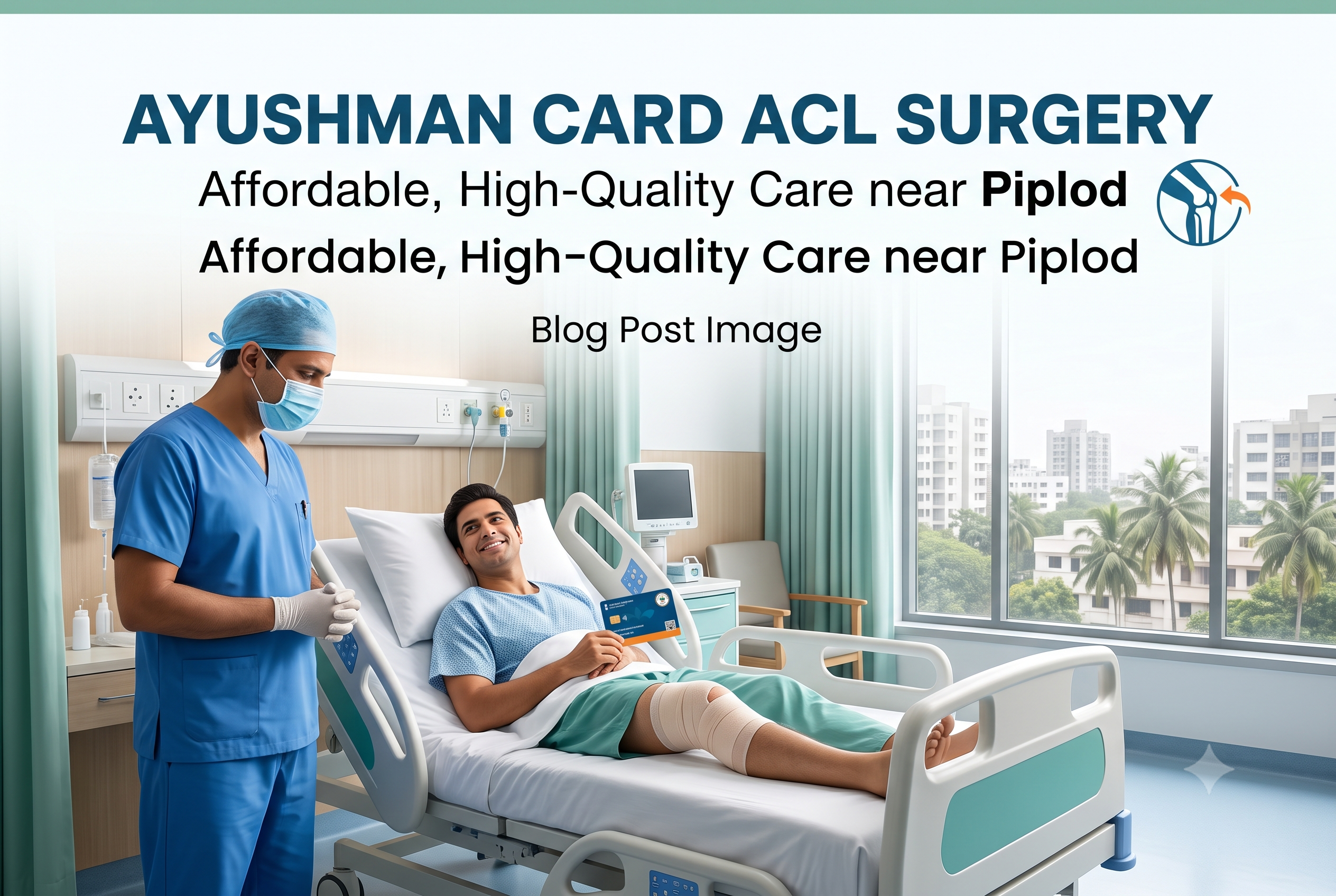
Piplod is one of Surat’s well-settled residential neighborhoods, home to a mix of long-time families, students, and young sports players who occasionally suffer serious knee injuries from sport, falls, or road accidents. A torn ACL, or anterior cruciate ligament, is a common but serious knee injury in this kind of setting, and if left untreated, it can leave the knee feeling unstable for years, leading to repeated giving-way episodes and long-term joint damage. The reassuring part is that ACL reconstruction surgery is covered under the Ayushman Bharat Pradhan Mantri Jan Arogya Yojana (PMJAY) scheme, and Ashirwad Hospital Surat, led by orthopedic surgeon Dr. Ankit Chaudhari, offers Ayushman card holders from Piplod a clear, nearby path to cashless, arthroscopic ACL surgery.
This guide explains what the Ayushman card covers for ACL surgery, how convenient treatment is for Piplod residents given the short distance to Ashirwad Hospital, the eligibility and documentation process, what the surgery and recovery involve, and answers to the common questions patients from Piplod ask before deciding on treatment.
Why Piplod Residents Choose Ashirwad Hospital for ACL Surgery
Piplod has several general clinics and diagnostic centers, but ACL reconstruction is a specialized procedure that needs more than a general orthopedic setup. It requires a surgeon experienced specifically in knee arthroscopy, MRI-based diagnosis to confirm the tear accurately, and a physiotherapy team trained in ACL-specific rehabilitation rather than general recovery exercises.
Ashirwad Hospital is easily accessible from Piplod, making it a convenient choice for patients who want specialized ligament surgery without a long commute, along with a team experienced in guiding Ayushman card holders through the entire cashless process from consultation to full recovery.
Is ACL Surgery Covered Under the Ayushman Card for Piplod Patients
Yes. Arthroscopic ACL reconstruction is listed as an approved orthopedic procedure under AB-PMJAY, meaning Piplod residents holding a valid Ayushman card can receive this surgery cashless at Ashirwad Hospital, since it is empaneled under the scheme. The scheme provides coverage of up to Rs 5 lakh per family per year, and the approved ACL package covers the surgery, arthroscopic equipment and graft fixation implants, hospital stay, and post-operative physiotherapy.
Private hospitals typically charge Rs 80,000 to over Rs 2 lakh for ACL reconstruction depending on graft type and implant used, a cost that puts timely treatment out of reach for many families in Piplod, particularly younger sports players and students who cannot afford to delay surgery but also cannot pay out of pocket. Ashirwad Hospital’s team manages the entire eligibility verification and cashless authorization process on the patient’s behalf, so families are not left navigating paperwork on their own.
Eligibility and Documents Needed From Piplod
Before visiting Ashirwad Hospital for a consultation, Piplod residents should prepare the following:
- Valid Ayushman Bharat Card (PMJAY Card) in the patient’s name or as part of an eligible family unit
- Aadhaar Card for identity verification
- Ration Card or family ID proof, where applicable
- MRI report of the injured knee, if already obtained, since ACL tears are confirmed through MRI rather than X-ray alone
- Any prior injury records, such as accident reports or initial treatment notes from a local doctor
Eligibility is based on SECC-2011 socio-economic criteria, and there is no minimum or maximum age restriction for this procedure, which is relevant given that ACL injuries commonly affect younger, sports-active patients and students in Piplod as well as working-age adults.
If you do not yet have an Ayushman card, you can apply through the nearest Common Service Centre (CSC) or check eligibility instantly through the Ayushman App using Aadhaar and ration card details. The card, once issued, has no expiry and can be used for this surgery as well as future health needs.
For an initial evaluation of a suspected ligament injury, our orthopedic diagnosis and treatment service is the right starting point, since Ayushman authorization requires documented clinical and MRI evidence of the tear before a surgery package can be approved.
Signs of an ACL Tear Piplod Residents Should Not Ignore
Many young sports players and students in Piplod continue playing or working on an unstable knee for months before seeking proper treatment, which often makes the eventual injury worse. Watch for these common signs of an ACL tear:
- A popping sound or sensation at the moment of injury
- Rapid swelling within hours of a twisting injury, fall, or accident
- Significant pain and difficulty bearing weight right after the injury
- A feeling that the knee is loose, unstable, or about to give way
- Difficulty fully straightening or bending the knee
- Repeated episodes of the knee buckling during sport, stairs, or uneven ground
- Swelling that keeps returning after activity, even weeks after the original injury
If these symptoms sound familiar, it is worth getting a proper MRI-based evaluation rather than continuing to play or work on an unstable knee, since repeated giving-way episodes can damage the meniscus and cartilage, turning a straightforward repair into a more complex reconstruction.
Step-by-Step Process for Piplod Patients at Ashirwad Hospital
Step 1: Initial Consultation and Knee Assessment Patients from Piplod can visit Ashirwad Hospital for a consultation with Dr. Ankit Chaudhari, who examines the knee, checks ligament stability through clinical tests, and reviews or orders an MRI to confirm the tear.
Step 2: Ayushman Card Verification The hospital’s Ayushman desk verifies the card and confirms eligibility for the ACL reconstruction package on the same visit.
Step 3: Pre-Authorization MRI reports and clinical notes are submitted for pre-authorization approval through the PMJAY portal.
Step 4: Surgery Scheduling Once approved, a surgery date is fixed, and the patient receives clear pre-operative instructions.
Step 5: Arthroscopic ACL Reconstruction The procedure is performed using minimally invasive arthroscopy, where the torn ligament is reconstructed using a graft, typically from the patient’s own hamstring tendon, through small incisions rather than open surgery.
Step 6: Hospital Stay and Early Physiotherapy Most ACL surgeries involve a short hospital stay of one to three days, with physiotherapy starting almost immediately to protect the graft while restoring early movement.
Step 7: Discharge and Structured Rehabilitation After discharge, patients follow a structured, phase-wise physiotherapy program, with the short distance back to Piplod making regular follow-up visits to Ashirwad Hospital easy.
Understanding the ACL Reconstruction Procedure
Unlike knee replacement, ACL reconstruction does not involve an artificial joint. The surgeon uses minimally invasive arthroscopy to remove the torn ligament remnants and replace them with a new graft, most commonly from the patient’s own hamstring tendon, secured with small fixation screws or buttons. This means smaller incisions, less post-operative pain, and a faster initial recovery compared to open surgery, though the graft still needs time to biologically mature before it can handle full stress from sport or daily activity.
Patients from Piplod often ask whether a meniscus tear found during the same surgery is treated together. In most cases, yes, since meniscus tears frequently accompany ACL injuries and are addressed in the same arthroscopic session, included within the same documented PMJAY package.
For patients with a partial tear or lower activity demands, our non-surgical treatments page outlines bracing and structured physiotherapy that can sometimes restore adequate stability without surgery, a decision made only after full clinical and imaging assessment.
Recovery and Return-to-Sport Timeline After ACL Surgery
- Weeks 1 to 2: Wound healing, swelling control, and gentle range-of-motion exercises under physiotherapist guidance
- Weeks 3 to 6: Walking without crutches typically resumes, along with light strengthening exercises
- Months 2 to 4: Progressive strength training, balance work, and controlled movement drills
- Months 4 to 6: Running and sport-specific drills begin gradually, under physiotherapy supervision
- Months 6 to 9: Most patients are cleared for a full return to competitive sport or regular work duties, based on strength and functional testing rather than time alone
Being close to the hospital is a real advantage during recovery, since Piplod residents can attend follow-up physiotherapy sessions without a long commute, which supports more consistent rehabilitation and lowers the risk of a repeat tear from returning to activity too early.
Why Piplod Families Choose Ashirwad Hospital
- Orthopedic and sports injury care led directly by Dr. Ankit Chaudhari, with hands-on experience in minimally invasive arthroscopy
- A dedicated team that manages Ayushman card verification and pre-authorization from start to finish
- In-house, structured physiotherapy covering the full rehabilitation journey, not just the surgery
- Easy accessibility for follow-up visits, given the short distance between Piplod and the hospital
- Clear guidance for athletes and active patients on realistic return-to-sport timelines, backed by our broader sports injuries care
Frequently Asked Questions
Can Piplod residents use their Ayushman card for ACL surgery at Ashirwad Hospital? Yes, Piplod residents can use a valid Ayushman card for cashless arthroscopic ACL reconstruction at Ashirwad Hospital, since it is empaneled under PMJAY.
How far is Ashirwad Hospital from Piplod? Ashirwad Hospital is easily accessible from Piplod within Surat city, making follow-up visits and physiotherapy sessions convenient after surgery.
Is ACL surgery completely free under the Ayushman card? For eligible cardholders at empaneled hospitals, the approved package cost is covered in full, including the surgery, graft fixation, hospital stay, and physiotherapy.
What documents should Piplod patients bring for the first visit? A valid Ayushman Bharat card, Aadhaar card, ration card where applicable, and an MRI report confirming the ligament tear, if already available.
Is there an age limit for Ayushman card ACL surgery coverage? No, the scheme has no minimum or maximum age restriction, which matters since ACL tears commonly affect younger, sports-active patients.
How long does recovery take after ACL surgery? Basic walking typically resumes within three to six weeks, while full return to sport usually takes six to nine months with consistent physiotherapy.
Can a meniscus tear be treated during the same ACL surgery? Yes, meniscus tears found during the same arthroscopic procedure are commonly treated in the same session, included within the same documented surgical package.
To check your eligibility or book a consultation with Dr. Ankit Chaudhari for Ayushman card ACL surgery, visit our contact us page, or learn more about our full range of care on the orthopedic services .